
By Neera Sharma
In Nepal, the writing is on the wall: the World Food Programme is reducing its footprint of direct implementation and providing technical assistance to the government in managing the National School Meals Programme.
Between 2017 and 2022, the Government of Nepal stepped up its efforts to bankroll school meals, increasing its budget allocation five-fold, and signaling a serious change in its approach to education, health, and nutrition. It is a new approach that no longer prefers using a stick to coerce children to learn but invests in an enabling environment that can nurture children’s cognitive skills and learning capacity.
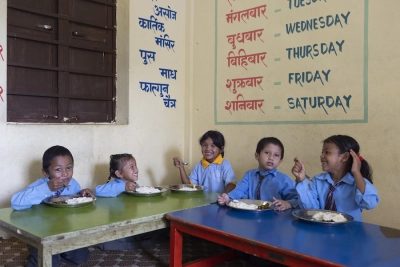
While the vision that all children must eat lunch in school is gaining momentum across the country, the government’s commitment to make it happen is becoming visibly clear with Nepal’s decision to join the School Meals Coalition in 2021. Later, in the fiscal year 2023-2024, the Government prioritized school meals, injecting USD 87 million into the school meals, which translates to about six-percent of the total national education budget. It is also the second largest allocation in the education sector followed by the expenses allocated for teachers’ salaries.
This budget commitment is significant, considering the history of Nepal’s national programme. In 2008, the government, through the Ministry of Education, Science and Technology, launched the diwa khaja karyakram (Midday School Meals) in five districts, reaching 250,000 children. Today, the Government of Nepal provides nutritious school meals to 3.3 million children, from pre-school to Grade 5, in 29,000 public schools across the country. The initiative now covers all 77 districts, including 100,000 students supported by WFP in three remote districts of SudurPaschim province.
During the COVID-19 pandemic, Nepal was one of the few countries in South Asia to quickly provide school meals to children on their doorsteps to prevent child-malnutrition. Take-Home Rations were distributed with funding from the United States Department of Agriculture (USDA), benefitting more than 200,000 children from seven food-insecure districts of Karnali and Sudur Paschim provinces. “Collaborating with the School Meals Coalition soon after the COVID-19 pandemic is opening new doors for school meals in Nepal,” said Dr Hari Lamsal, Joint Secretary from the Ministry of Education, Science and Technology. “With the technical assistance from WFP, we are stepping up our commitments to effectively and sustainably implement the school meals programme.”
Nepal is expecting partnerships within the School Meals Coalition to also help strengthen its technical capacity, particularly in building capacities to fully equip schools currently not providing school meals. The Ministry of Education also has the School Meals Standard and Facilitation Guideline for Community Schools, which sets minimum nutrition standards, and guides the implementation and management of the national programme.