
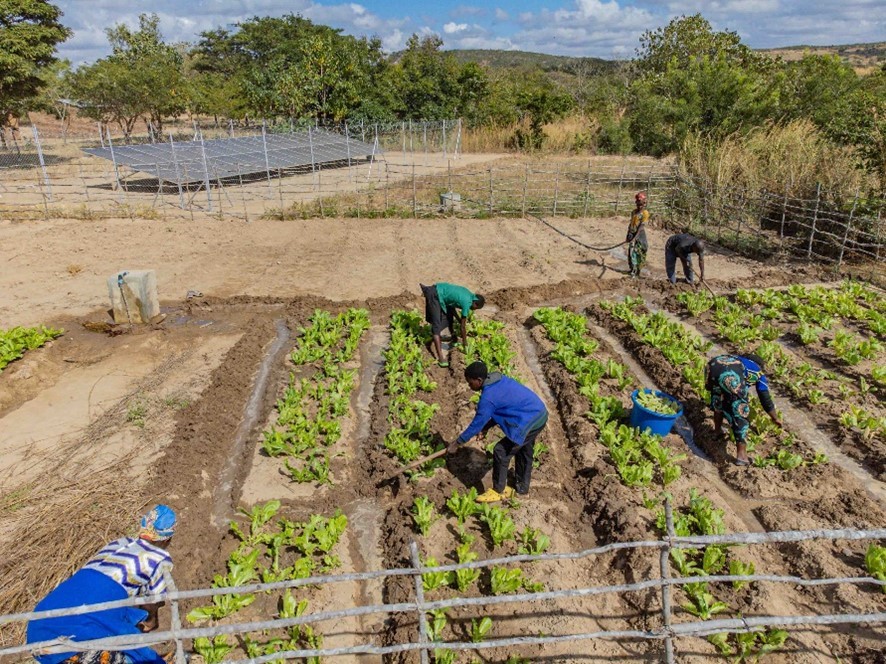
Local community members seen here working in the garden at Katuta school to help improve food production and support provision of school meals. Photo credit: Francis Thawani.
In rural Malawi, where only 23 percent of the population has access to electricity, the setting sun often marks the end of the school day – and the beginning of darkness. For many children, this means homework is rushed or skipped, and dreams of academic success fade with the light. But in three schools in Kasungu district – Katuta, Kasamba and Kaunda – a transformative initiative is changing that narrative.
Thanks to a clean energy project led by the Government of Malawi, with support from the Norwegian Agency for Development Cooperation (NORAD) and technical assistance of the World Food Programme, these schools are now powered by solar energy. Installed in 2024, the systems do more than light classrooms – they energize kitchens, irrigate school gardens and illuminate futures. The initiative began with a focus on clean cooking, aiming to reduce deforestation and the burden with firewood. But its impact has grown far beyond the kitchen. Today, these schools are hubs of innovation, where clean energy, education and nutrition intersect to create a model for sustainable development.
For students like Joseph Donex, a grade 7 learner at Katuta school, the change has been life-altering. “Since the solar lights were put in my school, I now come to school every evening to study because I have no lighting at home,” says Joseph. “With much effort on my studies, I am confident that I will do well in my exams. When I graduate from university, I want to become a bank manager.” Joseph’s experience is echoed by many students from the three schools. The availability of solar lighting has extended learning hours, allowing students to reclaim lost study time. For those living far from school, safety concerns once kept them away from studying in the evenings. Now with 150 rechargeable lamps available for rent at a modest fee, students can study at home. The funds collected – over 600 000 Malawi Kwacha (US$343), are reinvested in maintaining the solar systems, creating a self-sustaining cycle of empowerment.
But the transformation does not stop with lighting. The solar-powered irrigation systems have enabled the schools to establish thriving nutrition gardens. “With water available all the time, the garden is thriving,” says Paul Kalupsa, a solar system operator at Katuta school. “The school is growing vegetables such as mustard, cabbage and amaranth. Previously, the school was buying greens from farmer organizations but now we only buy seeds. We are saving money and ensuring children eat fresh vegetables every day.” This farm-to-plate model is a powerful example of how school meal programmes can strengthen local food systems. By growing their own food, schools reduce costs, improve nutrition and give students hands-on agricultural experience. These skills are not confined to the classroom – students are applying them at home and teaching their families, creating ripple effects throughout the community.
Teachers have noticed a marked change in student behaviour and performance. “Our enrolment has so far increased by 5 percent this year,” says Mr. Bonfansio Chirwa, headteacher of Katuta school. “Attendance is very good, and performance is just amazing.” He has also seen a surge in community engagement. “Parents and farmers visit the school garden to learn about irrigation and vegetable production. They are inspired by the new clean cooking and are supporting the kitchen staff.” As the sun sets over the rooftops of Katuta, Kasamba and Kaunda schools, the lights switch on – not just in classrooms, but in the lives of the learners walking in for their evening studies. These schools have become more than places of learning; but also models of resilience, hope, ambition and sustainability. By integrating clean energy solutions, school meals, water and local agriculture, Malawi is showing how a holistic approach to education can give hope to future generations – one meal, one light and one garden at a time.
Author: Francis Thawani is a communications officer at World Food Programme Malawi country office