
- Women farmers to supply 2,280 tonnes of rice to school meals, earning over US$2.3 million this year.
Overall local purchases for school meals are on the increase in Benin, injecting US$11.6 million into the national economy in 2023.
Benin’s Vice President, H.E. Mariam Chabi Talata is taking a lead in supporting women smallholder farmers to supply rice and other food items to Benin’s Integrated National School Meals Programme. This helps to put regular cash into the hands of women farmers and economically empowering them while ensuring their active participation in school meals.
Benin is a member of the School Meals Coalition, demonstrating a strong commitment to school meals, with President Patrice Talon recently signing the country’s national school meals commitments. The programme, providing hot lunch meals to over 1.3 million children across the country, is transitioning to government ownership and management with technical support from development partners. Buying school meal ingredients locally is crucial for the sustainability of the programme, and in 2023 alone, local purchasing increased to 53 per cent compared to 34 per cent in 2022.
The Union of Women Rice Parboilers based in the Collines region (URFER-C), has started delivering in phases 200 tonnes of parboiled rice worth over US$200,000. So far URFER-C has been able to deliver 40 tonnes of rice for school meals. This opportunity to supply the national school meals programme will go a long way in securing readily available markets for their produce following years of challenges in finding regular rice buyers in Benin.
In March 2022, Vice President Talata visited the Communal Cooperation of Rice Parboilers Processing Centre in Bantè, where, together with Myriam Pierre-Louis, the Head of Cooperation at the Canadian Embassy, met women rice producers. These women voiced their concerns and requests for support in securing good markets for their produce.
Reflecting on her visit to the Rice Processing Centre in Bantè, Vice President Talata noted that when she visited the first time, the women still had 220 tonnes of rice in their warehouse they had not been able to sell, “They had also not received payment for some of the rice they had delivered to a client in one of the neighbouring countries. Seeing these hard-working women in that difficult situation was heartbreaking. I then made a promise to find a way to assist them. Being a woman and a mother, I know that when women work and generate income, they use the proceeds to take good care of their children and families,” said Vice President Talata.
One market she had in mind, at the time, was the school meals programme. Not only would these women be able to sell their produce, but they could also benefit from the capacity building trainings focusing on improving storage and the quality of rice. “I felt this would allow them to become part of the Benin school meals journey,” she said.
Through a partnership with the World Food Programme (WFP), URFER-C is benefitting support to improve quality of their produce.
“This partnership with WFP is a huge encouragement for the government to expand the school meals programme and partner with more women farmers to supply other ingredients. Today we are talking about rice and next time we look forward to having more discussions on providing quality local produce to our schools such as fruit and vegetables, also coming from women farmers,” said VP Talata.
The Secretary-General in the Ministry of Agriculture, Livestock, and Fisheries, Ms. Françoise Assogba Komlan agreed with Vice President Talata that smallholder farmers, particularly women, stand to benefit more from the school meals programme.
"The outlook for 2024 is around 33,968 tonnes of rice, of which 19,493 tonnes are from smallholder-farmers. [...] The aim is to purchase at least 90% of school food from smallholder farmers. As the government looks to improving school meals nutrition, this will further create an impressive demand for additional supplies of fresh produce. This is good for the economy, and particularly the agriculture sector, where women constitute many smallholder farmers in Benin,” she said.
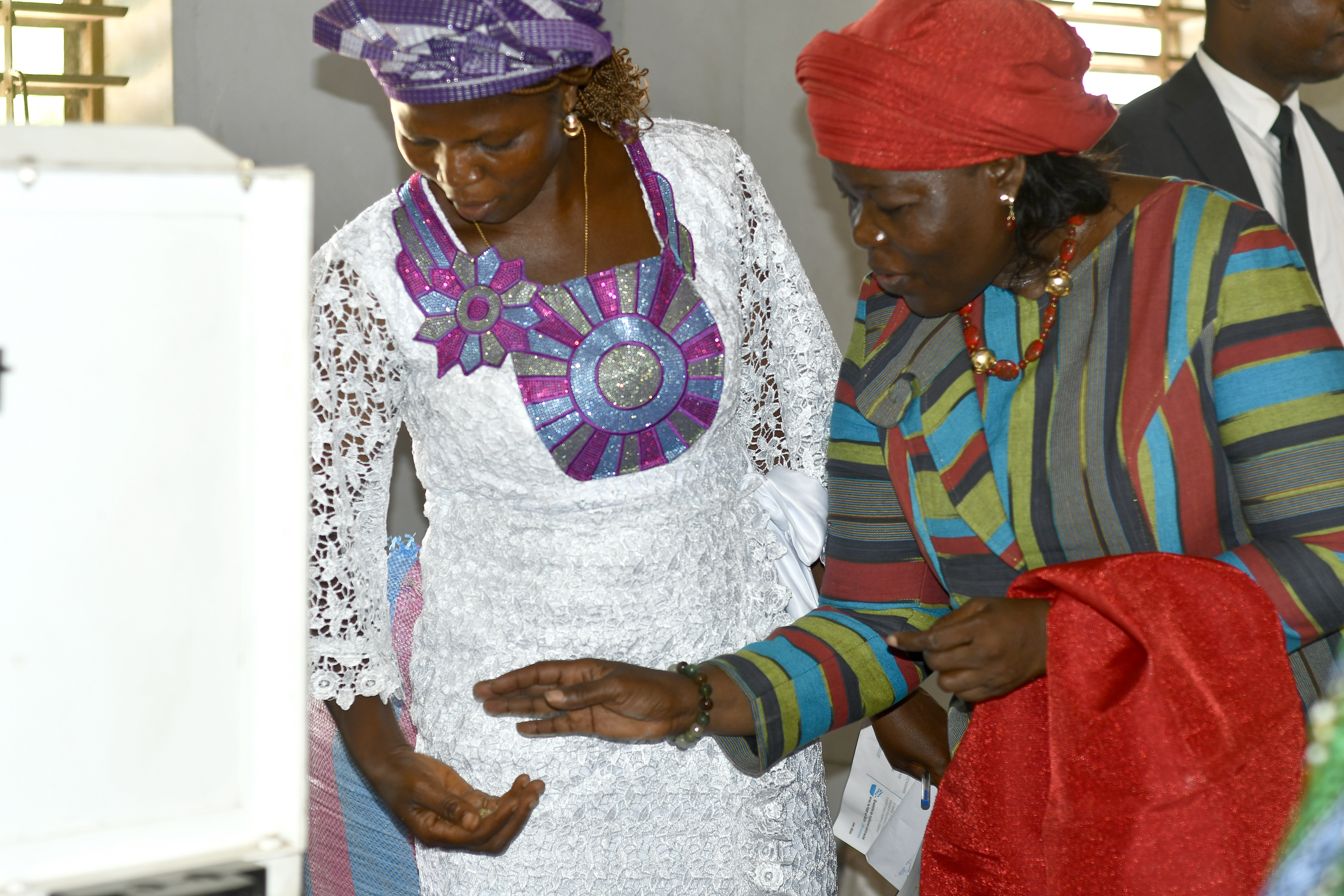
Ms Nanako Kagniahoun, Head of the Rice Processing Centre in Bantè said supplying rice to the school meals programme has motivated many women farmers to increase and diversify their production.
"This is turning around the rice business because selling the produce was difficult. This year, our rice stocks are at 300 tonnes, and we are reserving 200 tonnes for school meals. With a good profit, women can increase production and explore other crops in demand," she said.
With a regular income coming from doing business with the School Meals Programme, enterprises such as URFER-C can access credit and improve their operations, said Ms. Augustine Toto Agbanrin, the President of URFER-C.
"Many smallholder farmers and businesses in Benin are struggling to expand their enterprises because they cannot access enough funds. The last credit we got could only cover around 40 percent of our intended initiatives. We are still in debt to a microfinance institution because business was not good during the COVID-19 pandemic. This new partnership with the school meals programme will help us to service our debt and enable the expansion we envision. We would like to supply at least a thousand tonnes of rice to the school meals programme in the near future,” said Ms. Agbanrin.
Ms. Evelyne Dabiré, the Head of Cooperation in Charge of Affairs at the Canadian Embassy in Benin at the Canadian Embassy in Benin said it was heart-warming to see the school meals programme bringing so much joy and turning around the women’s businesses.
“They can now enjoy the fruits of their labour. This partnership with the school meals programme will help to expand rice farming and ensure sustainability of their businesses. We are very pleased to see the women playing a critical role in school meals and how this initiative economically empowers them,” said Ms. Dabiré.
In addition to partnering with the women rice farmers in Collines (URFER-C), there are prospects of two other women rice parboiler cooperatives also supplying rice to the school meals programme. Up to 2,280 tonnes of rice are expected, which will put over US$2.3 million in the hands of women farmers this year.
Mr. Ali Ouattara, Director and Representative at WFP in Benin said the volume of local purchases from smallholder farmers and other local suppliers has increased from 2,900 tonnes in 2017 to over 21,000 tonnes in 2023.
“This corresponds to US$11.6 million injected into the national economy in a single year.” He further explained that local purchases from smallholder farmers also increased from 300 tonnes in 2021 to 901 tonnes in 2022 and 7,622 tonnes in 2023, paying US$ 3.7 million to smallholder-farmers in 2023.