
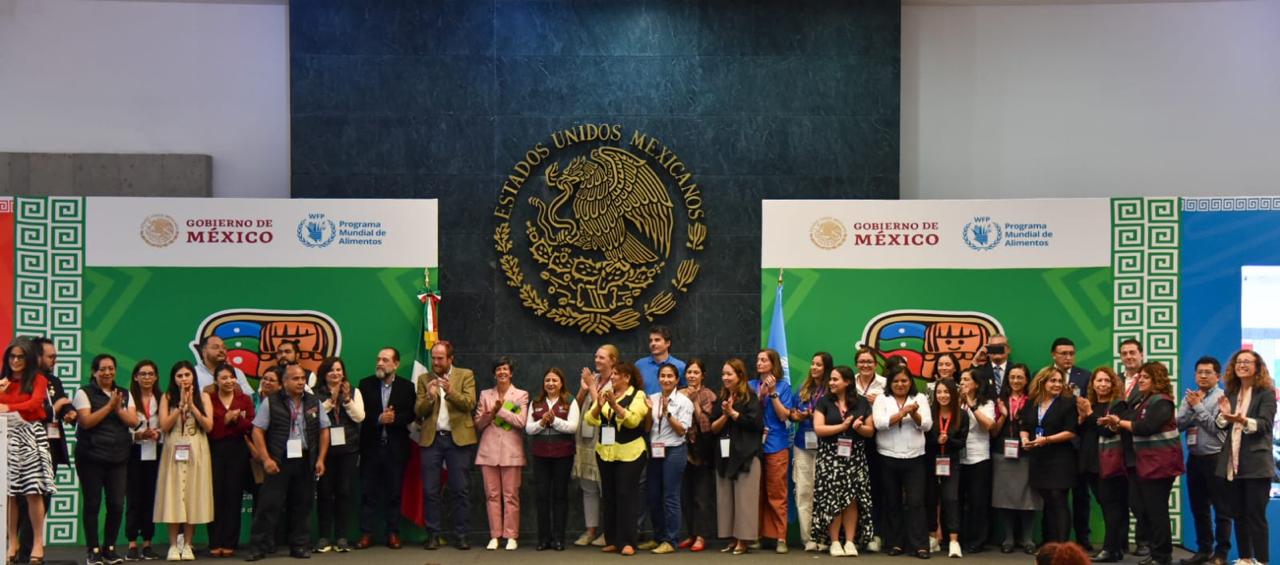
29 August 2024 – The School Meals Coalition has surpassed the 100-member milestone, with Uruguay announcing its membership as the 100th country at the 10th School Meals Forum held on 27-29 August in Mexico. Uruguay’s announcement was followed by Lao People’s Democratic Republic on 4 September and Jordan on 5 September, further expanding the Coalition’s strength and global influence in promoting school meals.
Uruguay’s commitment to ensuring the human right to adequate food for all students is evident from the government’s strong leadership in activities that promote sustainable school meals. They bring the number of countries in the School Meals Coalition from Latin America and the Caribbean to 20, in a move that will further expand the Coalition’s strength in the region and influence in promoting school meals at global level.
“We are excited to be one of the new member states to join the School Meals Coalition. This is such a huge motivation for the government and our partners to continue improving the quality of school meals we deliver across the country. Our joining the Coalition demonstrates strong commitment and readiness to collaborate with other countries to ensure children, from early childhood until adolescence, can receive healthy meals in school – not only in Uruguay but also globally,” said Uruguay’s Director General of Initial and Primary Education Ms. Olga de las Heras.
The Government of Laos is committed to expanding its national school meals programme, currently providing meals to 250,000 and primary school children to address child malnutrition. Over 33% of children in Lao PDR suffer from chronic malnutrition, affecting their cognitive development and academic performance. “Joining the School Meals Coalition is a critical step forward in our national strategy to improve child health and education. Nutritious school meals are essential not only for student health but also for their academic success, to become qualified human capital for a more developed country," said Associate Prof. Dr. Phout Simmalavong, Minister of Education and Sports in Laos.
In Jordan, the National School Meals Strategy prioritizes the gradual transition of the programme to the Ministry of Education, demonstrating the government’s national commitment to own and manage a sustainable programme. Delivering school meals to 520,000 students, the programme is the largest safety net for children in the country, covering over 60% of primary school children in public schools. Jordan is prioritizing scaling up its home-grown Healthy Meal modality, employing 250 women to cook school meals using ingredients sourced from local smallholder farmers and bakeries.
The newest member announcements comes at a time when the School Meals Coalition is experiencing a steady rise in its membership with South Korea and Djibouti also recently joining the Coalition. Launched in 2021, under the co-leadership of Finland, France, and Brazil, the School Meals Coalition has inspired governments to invest more in building sustainable school meal programmes. Currently 48 governments have shared their national commitments to scale up and improve quality of their programmes, leveraging local and global partnerships. Actions have galvanised the support of over 130 development partners promoting programmes in various countries. The Coalition’s First Global Summit held in Paris in October 2023 saw over 100 civil society organisations launching a “Call to Action” in support of governments’ efforts to achieve their national commitments.
An idea born in hard times
The COVID-19 crisis forced almost all schools to shut down, disrupting the learning of hundreds of millions of children and affecting the provision of school meals. The pandemic’s devasting effects on children’s learning, health, and nutrition prompted an idea to establish the School Meals Coalition to influence governments and partners to restore programmes. The thinking behind building a Coalition was to lay down favourable conditions that would promote a new form of multilateralism based on country solutions grounded in evidence, to address global problems. The Coalition was created to break silos between sectors and partners and foster progress on some of the most pressing global priorities.
As school meals conversations gained momentum in the past three years, the Coalition has managed to dismantle the notion of north and south, donor and beneficiary, recognising that every member and partner has something to contribute and learn.
The threat of global crises and the compelling case of school meals
The progress experienced in school meals after the pandemic was threatened by the outbreak of the Ukraine armed conflict in 2022. The conflict attracted global attention, shifting the flow of aid that was supporting programmes such as school meals in some countries. This shift also worsened the hunger crisis, leaving 733 million people the world over in need of food and nutrition assistance (SOFI, 2024).
The Coalition mounted a compelling case for school meals, pointing out programmes’ positive impact on education, food systems, health and nutrition, gender equality, social protection, environment and climate action as well as water, sanitation and hygiene (WASH).
Platforms including the African Union, the European Union, the Sustainable School Feeding Network (RAES) in Latin America and the Caribbean, the Association of Southeast Asian Nations (ASEAN), the G7, G20, United Nations, and the Economic Community of the West African States (ECOWAS) have played a critical role in promoting school meals around the world.
And despite financial difficulties in many countries, global investment in school meal programmes between 2021-2022 jumped from USD 43 billion to USD 48 billion, with school meals coverage increasing by 30 million children, to 418 million children compared to early 2020.
Beyond the 100 Governments
As school meals evolve, the Coalition is widening its horizons to expand its membership and partnerships, introducing new innovations and initiatives to improve quality of support to governments. Since the launch of the Coalition, many governments have been identifying and utilising partnerships providing technical assistance supporting initiatives such as planet-friendly school meals and connecting their programmes with local food systems. Many countries are also prioritizing exploring sustainable ways to finance their school meal programmes. These needs are what strengthen the School Meals Coalition’s resolve to work with all governments and reach all children with nutritious meals by 2030.
The path forward requires continued collaborative efforts and connecting governments to benefit from where others have progressed. The work of the School Meals Coalition Initiatives – the Research Consortium of School Health and Nutrition, Sustainable Financing Initiative for School health and Nutrition, Cities Feeding the Future and the Data and Monitoring Initiative have become even more important as governments become more ambitious in their investment in school meal programmes. Other Coalition partners are also doing a lot of heavy lifting in support of efforts shaping programmes in many countries.
As the School Meals Coalition celebrates this great milestone, we know the road ahead will not be easy. It will demand agility, sustained collaboration, trust, and unwavering commitment from all actors. By aligning with government policies and leveraging collective expertise, the School Meals Coalition can continue to multiply the impact of school meal programmes providing sustainable, nutritious meals for all children around the world.