
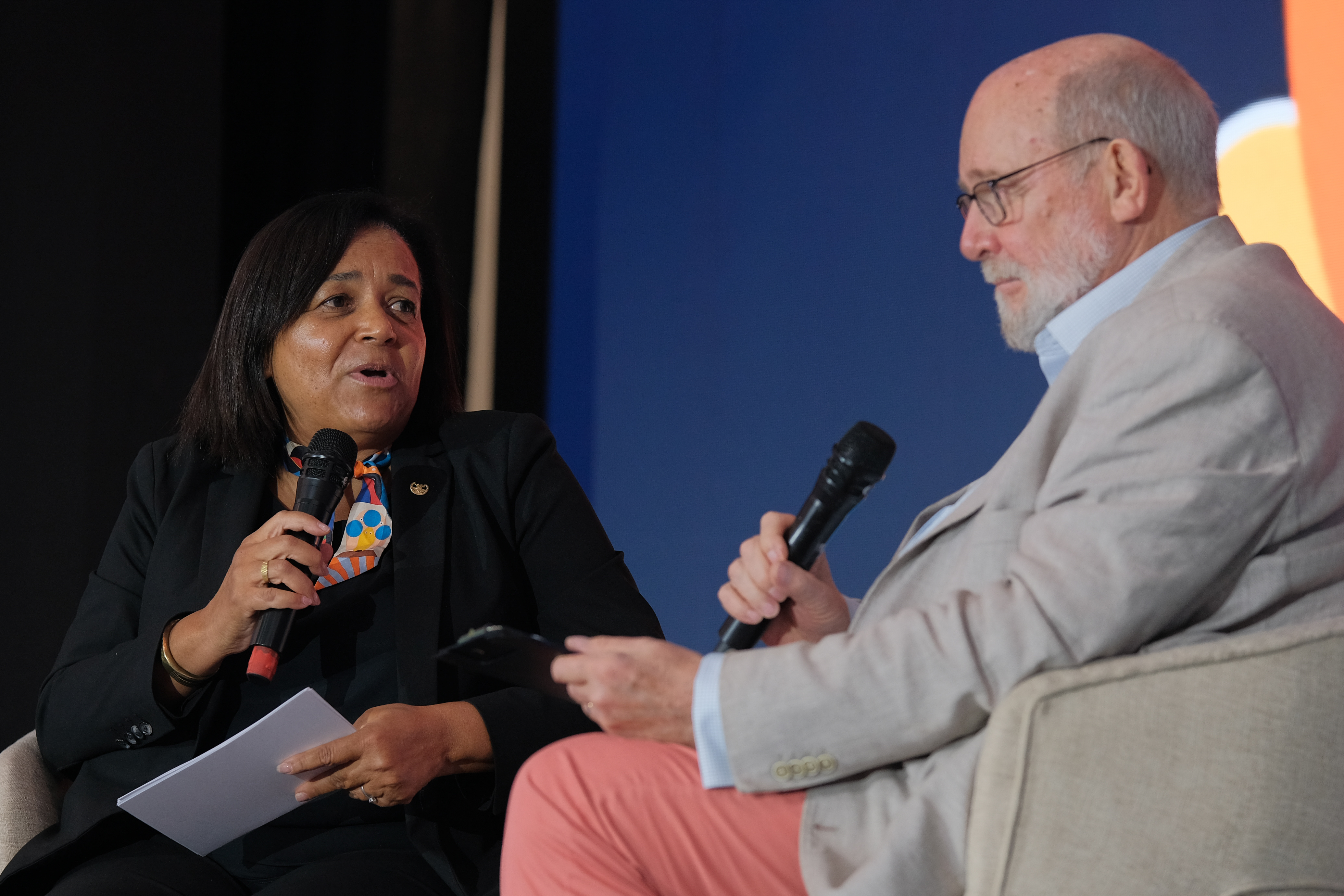
At the School Meals Coalition Summit held in Brazil, WFP’s Assistant Executive Director, Ms. Valerie Guarnieri joined Professor Donald Bundy, Director of the Research Consortium for School Health and Nutrition, for a fireside conversation on the vision and growing momentum behind the Planet-Friendly School Meals. Their discussion explored practical strategies for making school meals more sustainable and highlighted upcoming plans to launch a new White Paper and Toolkit, resources designed to help governments advance planet-friendly school meal programmes.
Q: Two years ago, in Paris, we spoke about planet-friendly school meals and the White Paper. Can you explain the conceptual framework behind this school meals initiative and its growing importance today?
Professor Bundy: The development of the White Paper on planet-friendly school meals, involved 160 authors from 87 organizations worldwide. We presented our findings at COP28 in Dubai, highlighting the crucial role of school meals in combating climate change. That paper has inspired an upcoming curated collection within The Lancet Planetary Health, providing technical details for interested readers. The key takeaway from COP28 marks 28 years of discussions surrounding climate, primarily focused on the impact of oil, gas, and fossil fuels. This was the first time food was fully integrated into the agenda, with school meals taking center stage. I believe this shift is worth exploring further.
Q: Based on current research, what strategies can countries adopt to make school meals more planet-friendly in the short and long term?
Professor Bundy: School meals are public policy programmes, not external aid programmes. The food procured by governments falls under their policy control, with 70% allocated for school meals, while the remainder goes to prisons and hospitals. This dominance gives governments the power to implement change. We identified four areas where they can have immediate impact: shifting menus toward diverse, local, and nutrient-dense foods, particularly indigenous options. For example, Nepal’s school meals programme expanded from three crops, mostly imported, to 18 locally grown crops.
Secondly, efficient cooking methods are crucial, as much of the world, particularly Africa, still relies on three-stone wood fires for food preparation, which is ecologically problematic. Thirdly, food waste accounts for a third of all greenhouse gas emissions, with significant emissions stemming from discarded food, so reducing waste also addresses financial concerns. There are clear strategies for minimizing waste through better planning and education on food consumption. Fourth, we must embed holistic food education in the curriculum to change young people's relationship with food at school, which will influence their lifelong habits.
We can create a whole new generation that has a different relationship with food, choosing sustainable options preferentially. While changing adult behavior is challenging, we can influence children, setting a positive trajectory for the future.
Q: Regarding long-term benefits, the focus is on procurement rules, do they include climate considerations and environmental and socioeconomic factors?
Professor Bundy: They should, as this will determine what food is ordered, and 70% of food ordered by governments can align with this vision, helping to transform food systems. By choosing these crops, we support specific groups within communities, particularly women farmers, which is a more sustainable long-term response. However, we can see that there are four rapid responses and one we will see play out over the future.
Q: With the 70% government procurement, how is the Research Consortium helping countries implement these best practices?
Professor Bundy: The Rockefeller Foundation and the Novo Nordisk Foundation are supporting our work with countries to develop a toolkit that helps governments make informed decisions on dietary changes and waste management. This toolkit will assist in evaluating the costs and benefits of crop selection and clean cooking options, developed as part of our global academy with over 1,200 professors and practitioners across 124 countries. We are particularly focusing on Kenya, Rwanda, Uganda, and Ethiopia as pilot countries for this analysis, hoping to roll out the toolkit later this year.
Q: What’s next on the research agenda, Professor Bundy?
Professor Bundy: We are excited to examine the impact of school food procurement on food production methods, specifically addressing soil health and regenerative agriculture. There is a real interest in soil degradation among agricultural research communities. Though we have used rotating crops for centuries, recent farming practices have led to increased soil degradation. We need to restore soil quality, and we are looking to use school meal procurement to advance this agenda.
Our initiatives include establishing a community of practice dedicated to food systems transformation and collaborating with the Agro-biology Coalition to engage farmers in these discussions. Changing young people's relationship with food can significantly impact health and healthcare economics. These areas are critical to our work, and we are about to launch a new White Paper featuring contributions from many authors and organizations, aiming to have preliminary findings by June 2026. I have enjoyed this meeting, particularly yesterday's discussions on the growing importance of school feeding programmes and their potential impact on both human and planetary health. Together, these efforts can equip countries with actionable tools and evidence to make school meals more sustainable and planet-friendly.