
Lao PDR is at a pivotal moment in our journey to improve child nutrition and education. In September, we signed the declaration to join the School Meals Coalition, a global alliance dedicated to enhancing child nutrition, education and wellbeing through comprehensive school meal programmes. By joining the School Meals Coalition, we are not only reaffirming our commitment to the wellness of our children, but also opening a new door to a world of knowledge, innovation and collaboration we hope will transform our National School Lunch Programme.
School meals are amongst the most powerful essential services we can provide to our children. Studies suggest that returns from school meal programmes are substantial, up to USD 8 for every dollar invested. Children benefiting from school meals stay in school for an additional half year longer than their peers without school meals, according to the 2018 Cost-Benefit Analysis of the School Meals Programmes in Lao PDR. These programmes not only improve education outcomes, but they are also instrumental in advancing the nutrition and health of our children, while helping families fight food insecurity. School meals have been on our minds for over two decades. Since 2010, we have a national programme, and the 2020ies marked tangible commitments with funds allocated from the national budget. A dedicated decree on promoting school lunch was issued by the Government of Lao PDR in 2022. Today, nearly 250,000 children eat healthy food in about one quarter of all primary schools in Laos.
Of course, our goal is to provide school meals to all children across our country!
We are committed to this goal because we now understand that school meals are more than just food — they are a powerful tool to combat malnutrition, improve education outcomes and foster sustainable development. Ensuring that every child receives a nutritious meal at school is both an urgent priority and a long-term investment in our nation's future and human capital.
Now is the time to move forward. Today, some families encounter difficulties to meet their food needs. The National School Lunch Programme is invaluable for these families, and we need all hands-on deck to stabilize and empower existing school meal programme structures, at the same time continuing to expand and strengthen them. This is where we think the School Meals Coalition can help us. Launched in September 2021, during the United Nations Food Systems Summit, and now co-chaired by France, Finland and Brazil, its goal is to ensure that all children receive a nutritious meal at school every day by 2030. The inaugural global summit of the School Meals Coalition took place in Paris in October 2023, under the high patronage of the French President. 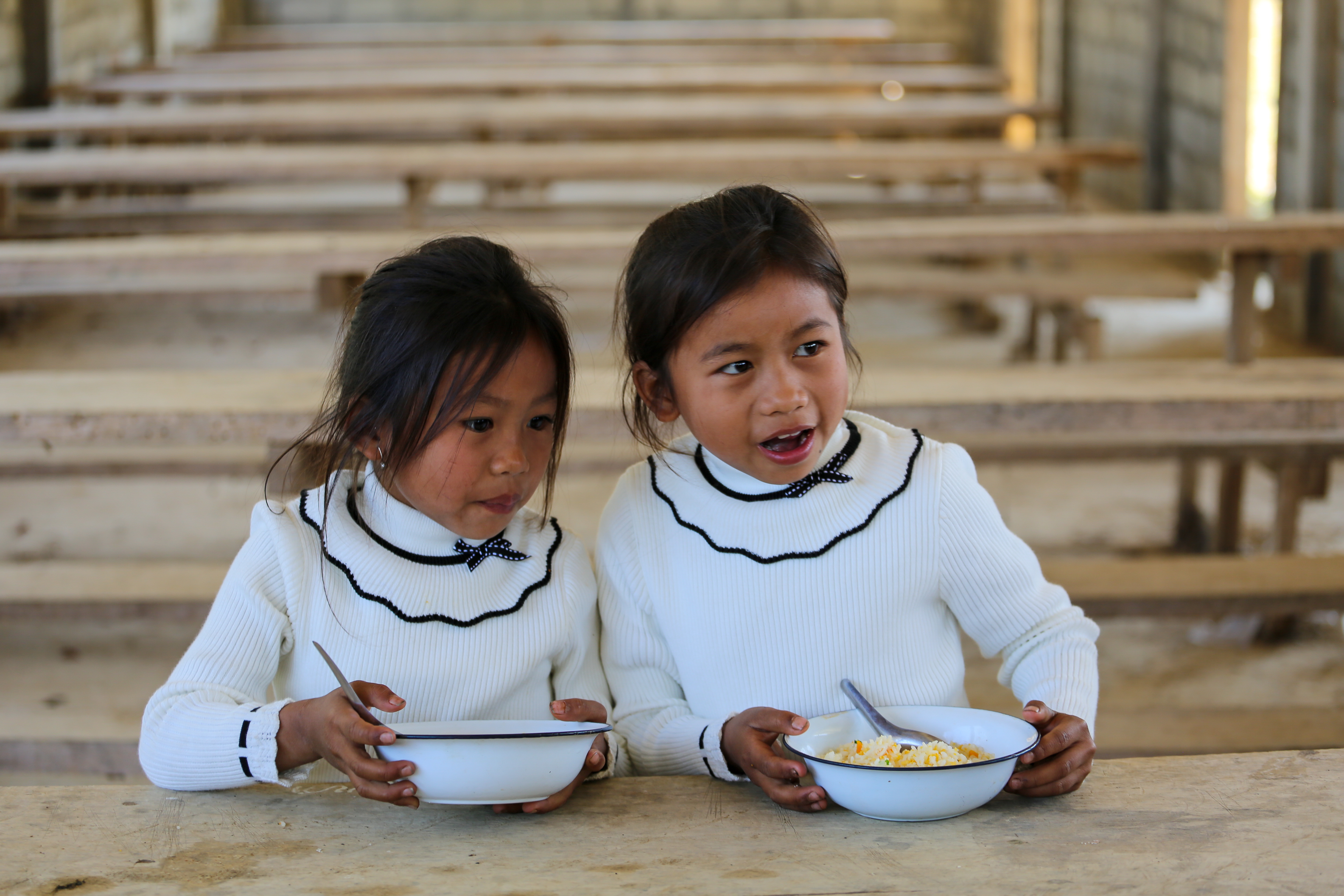
The Coalition represents a global alliance of over 100 countries and over 130 partners committed to making nutritious school meals a universal right by 2030. Members and partners come from all continents and represent every stage of development, including countries with decades of successful school meals implementation. By aligning with this Coalition, Lao PDR will benefit from their collective experiences and innovations. We will learn from their successes and challenges, adapting best practices to our local context.
One of the most significant opportunities that this membership offers is the chance to shift towards buying the food we supply to our schools locally, by creating a link between local farmers, especially smallholder farmers and schools. Most countries with functioning, sustainable school meal programmes rely on this concept, because it supports local farmers and reduces dependency on external food sources, while also promoting sustainable agricultural practices. The recently launched Association of Southeast Asian Nations (ASEAN) Minimum Standards for School Nutrition includes one standard on local procurement to sustain food supply in schools. Our participation in the Coalition will accelerate our existing efforts in creating a local supply chain to schools, enabling us to promote low-carbon diets that are not only healthier for our children, but also better for the planet. We strongly believe that climate action must be at the heart of our school meals strategy. By adopting sustainable agricultural practices and promoting diets rich in local, seasonal produce, we can reduce the carbon footprint of our school meals, while supporting our farmers and helping to preserve the environment.
School meals also play a critical role in empowering women, who make up the majority of the workforce involved in food production, preparing and serving these meals. As we expand and enhance the quality of our programme, we must continue to support these women with decent pay, training and opportunities for advancement, recognizing the vital role they play in improving our children's health and education. What this all means is that, with the help of the School Meals Coalition, our schools have the potential to drive poverty reduction and development for the whole of our country, kicking off a cycle of demand and supply that can lift rural communities out of poverty. This, in turn, will ensure a strong workforce for the coming years.
Joining the School Meals Coalition is a significant milestone in our ongoing efforts to build a stronger, healthier and more educated society. It is a commitment to our children, our communities and our planet. By harnessing global expertise and embracing innovation, we are confident that Lao PDR can create a school meals programme that is locally rooted, climate-friendly and transformative for generations to come.
This article was co-authored By H.E. Assoc. Prof. Dr. Phout Simmalavong, Minister of Education and Sports, Lao PDR and Marc-Andre Prost, WFP Representative and Country Director in Lao PDR, with contributions from the Embassy of France to Lao PDR.