
By Luise Shikongo in Namibia
The Namibia School Meals Programme has demonstrated extraordinary resilience since its establishment in 1991, only a year after the country gained its independence. In 1996, the government, through the Ministry of Education, Arts and Culture, took over full responsibility to implement the programme, following a strong partnership with the World Food Programme, which from 1991 had worked to strengthen government’s capacity.
Over the years, the programme has rapidly expanded to reach over 78,000 children in 1996; 330,000 in 2015; and currently 466, 860 children in over 1, 514 schools in all 14 regions of the country. The government has sustained its investment in school meals due to tangible improvements in education, which include an increase in enrolment and retention of learners, especially girls, and the impact of meals on the health and learning capacity of vulnerable children.
As the school meals evolved, the government also realised that a more holistic approach that is more inclusive of various stakeholders would further improve the quality of the programme and benefits. This led to the recent rolling out of a home-grown school feeding pilot, in 29 schools located in seven regions, while running the national school meals programme in all 14 regions. Namibia’s Ministry of Education is leading a “Value for Money” study in partnership with Harvard University and WFP. The goal is to enable assessment of the comprehensive sectoral cost and benefits of school meals to support programme strengthening.
With indications that the home-grown school feeding model offers more benefits, a plan is in motion to fully adopt the model and roll it across the country. Namibia’s ambitious plan will see the government expanding provision of school meals to children currently left out, including those in early child development centres and secondary day schools. According to Minister of Education, Arts and Culture, Honourable Anna Nghipondoka, the government wants to fully tap into the benefits of the home-grown school feeding model. The potential to boost the rural economy and the model’s impact on the country’s food systems and climate action have made home-grown school feeding more attractive and in line with the government’s development agenda. The government has identified ways to promote production of nutritious food in school gardens using agricultural methods and techniques to mitigate the effects of severe climatic conditions.
“Although Namibia is an arid country that often experiences severe droughts, we would like to promote school gardens to boost the nutritional value of our school meals. However, these gardens require water. We have installed drip irrigation systems and provided greenhouses to create conducive conditions for schools to sustain food production,” says Minister Nghipondoka. The government is also promoting regenerative agricultural practices, encouraging schools to use organic manure to further improve the quality of soil and produce. “We are devising innovative ways to grow food and maximizing our strategy to go organic and provide planet-friendly school meals.”
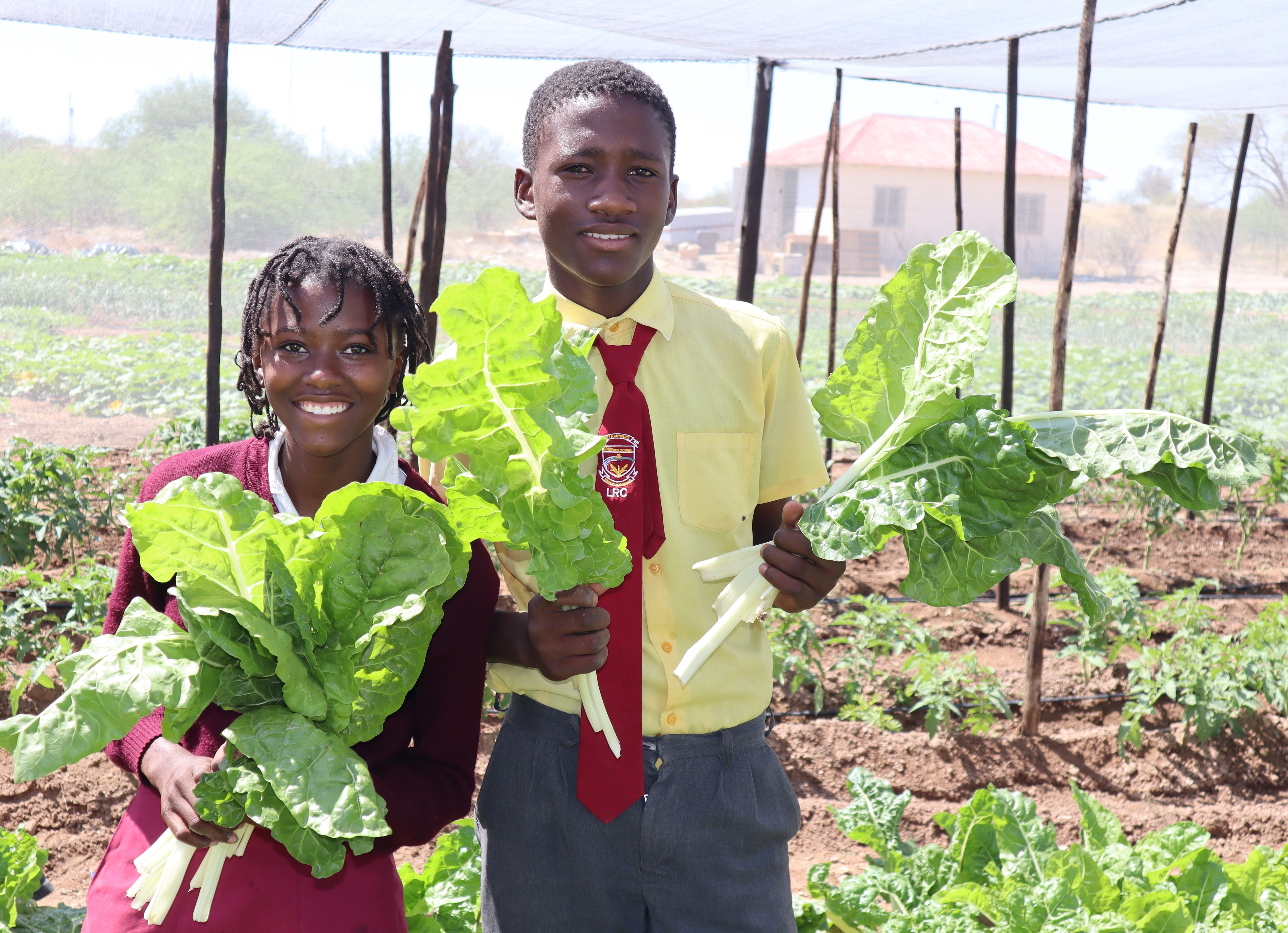
The pilot has proved that its benefits go beyond school meals. “Through the programme, we are collaborating with the local communities, smallholder farmers especially and local businesses. This will go a long way to grow the rural economy and make sure everyone benefits. We are using the school gardens to influence local communities to also learn and adopt the practices and techniques we are promoting. That way, they will be able to supply the quality of ingredients we are looking for to provide planet-friendly school meals.”
Minister Nghipondoka says the notion of “planet-friendly school meals” has also become a source of inspiration to smallholder farmers who are excited to adopt new ways of growing food through school gardens. In many areas, school gardens have become centres for learning where local communities, particularly women smallholder farmers, are acquiring knowledge and skills they can use to improve their lives and contribute to the government’s efforts in strengthening school meals.
“Without the smallholder farmers, we cannot guarantee fresh supplies in schools. They are our important partners.” These partnerships, she says, are also contributing to efforts to accelerate food systems transformation. “As we put some money in their hands, the farmers are economically empowered, they can produce diverse vegetable varieties, and start thinking about value addition,” says Minister Nghipondoka
Dr. George Fedha, WFP’s Country Director and Representative in Namibia applauded the government for promoting the home-grown school feeding model. “Acting as safety nets, home-grown school feeding can contribute not only to create food access for vulnerable school-aged children; but also, generate income and strengthen human capital development pathways and food systems. Because of this connection, home-growing the food supply has the potential to multiply the effects of school meals to local economies.”
The home-grown school feeding model, he adds, provides opportunities for catalytic and green growth by making schools centres for economic productivity and climate action. “Importantly, as we are seeing in Namibia, learners are participating first hand in advancing food systems and tackling climate change.”
Namibia joined the School Meals Coalition in 2021 and is using it to share best practices, learn from other countries and showcase its innovation and partnerships with smallholder farmers to provide learners planet-friendly meals against all heavy odds.