
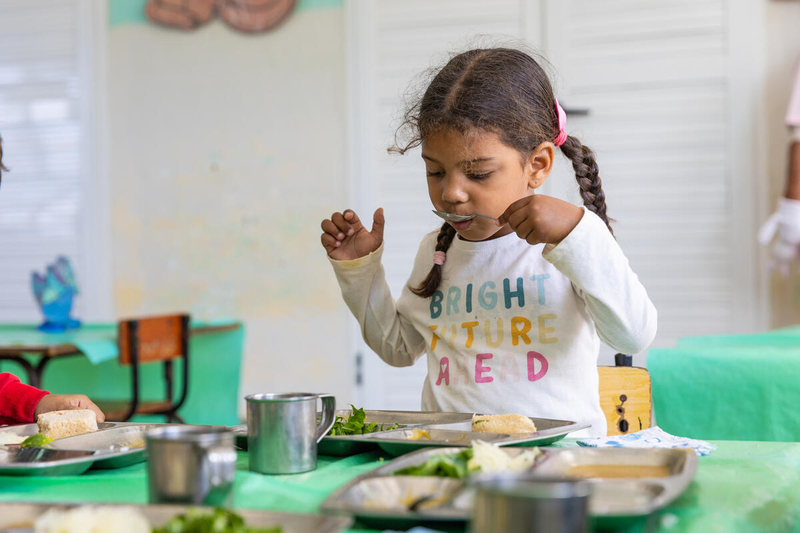
A learner from Cuba enjoys her lunch meal in class. WFP/Irshad Khan
In Latin America and the Caribbean, millions of children arrive at school with empty stomachs. It's a hard fact to digest in a world that produces enough food for everyone. For many, school is not only a place of learning but the only place where they can count on a nutritious meal each day. For their families—especially in vulnerable communities—school feeding programmes are much more than a supplement: they are a real, daily, and silent safety net.
Feeding children at school is not just a matter of social assistance; it is one of the most effective interventions to improve educational outcomes, reduce school dropout rates, and break cycles of poverty. While countries have managed to recover some of the ground lost during the pandemic, food insecurity continues to hit hard. The paradox is that Latin America and the Caribbean is one of the world’s largest food-exporting regions—producing enough calories to feed 1.3 times its population—yet putting food on the table costs more here than anywhere else: $4.56 per person per day, according to the United Nations World Food Programme (WFP).
Moreover, rising temperatures and disasters could increase that cost by up to 34% by 2050. The result? Around 180 million people in the region lack access to adequate nutrition. In this context, school meals become one of the few tools capable of ensuring minimum nutrition for millions of children.
“The paradox is that Latin America and the Caribbean is one of the world’s largest food-exporting regions, yet putting food on the table costs more here than anywhere else: $4.56 per person per day.”
— Mercedes Mateo, Head of the Education Division at the IDB, and Lola Castro, Regional Director of WFP for Latin America and the Caribbean
And the problem isn’t just the lack of food. Eating well has become as challenging as eating enough. Childhood overweight and obesity are growing faster here than in other parts of the world, while micronutrient deficiencies still affect more than half of school-aged children. Nearly one-third of children and adolescents are overweight—a level that among adults is nearly double the global average.
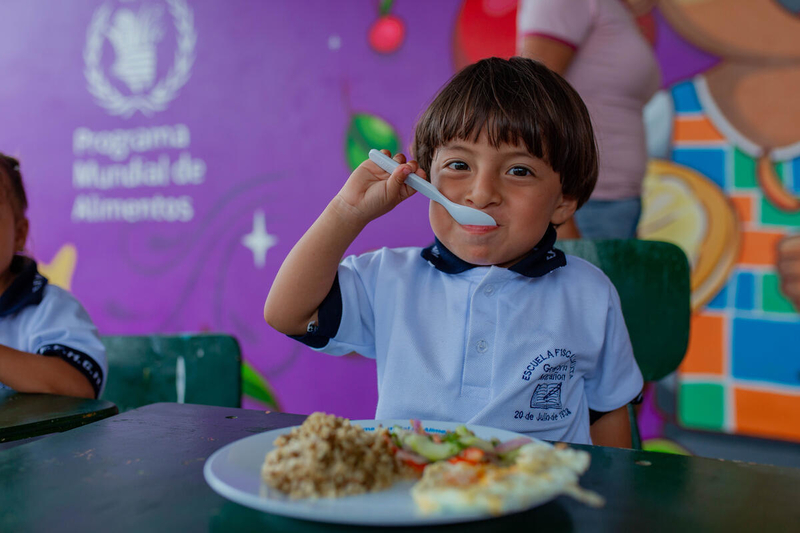
A boy from Ecuador smiles as he eats his nutritious meal. WFP/Gonzalo Ruiz
In this scenario, school feeding programmes take on even deeper meaning and have truly transformative potential. They can ensure continuity and stability in crisis contexts—from droughts to forced displacement. When well-designed and linked to local agriculture, they not only nourish students but also create jobs, stimulate rural economies, strengthen food system resilience, and preserve food heritage. This is demonstrated in the new report by the Inter-American Development Bank (IDB) and WFP, More Than a Meal, which analyzes cases in Guatemala and Peru. The evidence is clear: when there is institutional commitment, technical strength, and community participation, school meals multiply their impact.
In Guatemala, balanced school menus can reduce the cost of a healthy diet for children by up to 62%, while in Peru, the savings for families can represent up to 54% of their children’s healthy food costs. We also know that ultra-processed foods and junk food not only harm children’s health but can increase their diet costs by up to 20%. This is a revealing fact in a continent where consumption of these products has skyrocketed, especially among low-income families.
“School feeding programs stand out as highly effective platforms for reaching the most vulnerable populations with fortified foods.”
— Mercedes Mateo and Lola Castro
Evidence also shows that fortifying school meals and providing supplements are effective and cost-efficient strategies to tackle malnutrition. For example, in adolescent girls starting menstruation, iron and folic acid supplements prevent anaemia and help them stay energized, improve learning, and enhance concentration.
If all school lunches included fortified rice, countries like Peru could reduce the cost of a nutritious diet by 26%.
Today, more than ever, we have the opportunity—and the responsibility—to scale what we already know works. From the IDB and WFP, we invite governments, communities, and partners to put this agenda at the center. Because no child should have to learn while hungry. And because a meal can be much more than that—it can be the beginning of a different future.
About the authors: Mercedes Mateo is the Head of the Education Division at the Inter-American Development Bank. Lola Castro is the Regional Director of the World Food Programme for Latin America and the Caribbean.
This opinion piece was originally published by El Pais on 4 August.