
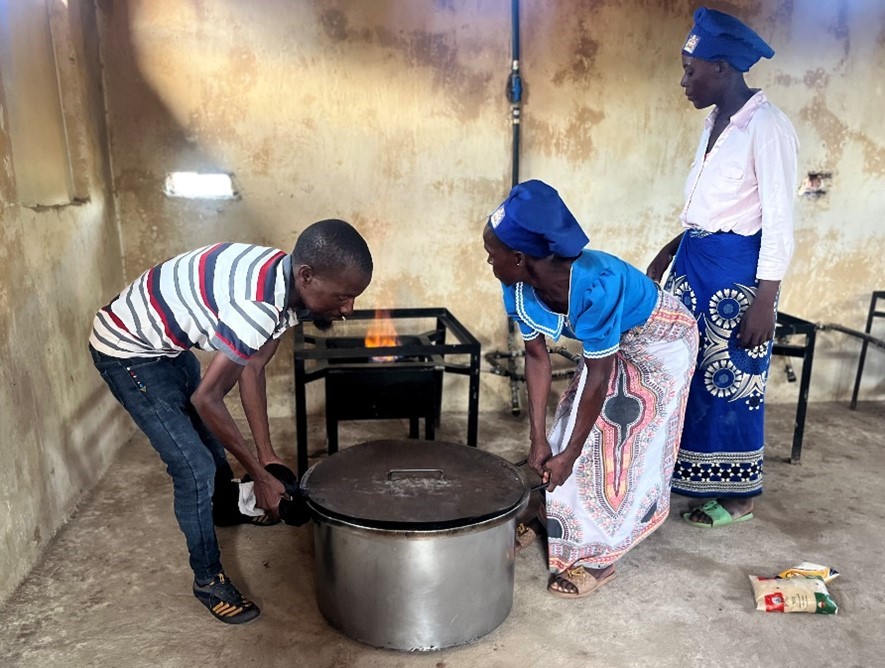
Cooking simplified. At the scratch of a match, chefs at Mtowe school have the required flame to cook meals for all children. Photo credit: WFP/Patricia Cepeda
By Francis Thawani
Malawi is pioneering clean, renewable cooking solutions in 13 schools across Chikwawa and Kasungu districts. Using biogas from organic waste and solar-powered cookers to prepare school meals, these schools will reduce air pollution while generating income and exploring carbon credit opportunities, supporting Malawi’s shift to clean energy
Globally, 2.3 billion people—over a third of the world’s population—do not have access to clean, efficient, safe, and affordable cooking solutions. Consequently, they remain exposed to the negative health, environmental, and socioeconomic impacts of traditional cooking. Age-old cooking practices, which rely on biomass, contribute to deforestation, air pollution, and respiratory diseases, leading to 3.2 million premature deaths annually—more than tuberculosis, malaria, and AIDS combined.
In Malawi, the government is working with partners on taking bold steps to integrate clean energy solutions that will adopt biogas from organic waste and solar-powered cookers, to mitigate the effects of reliance on traditional biomass fuels while ensuring students receive nutritious meals in an environmentally friendly way.
At the forefront is a groundbreaking initiative bringing clean, renewable cooking solutions to 13 schools in the Chikwawa and Kasungu districts. This innovation will strengthen efforts to conserve forests, reduce air pollution, and address food insecurity by transforming organic waste into biogas and biofertilizers and utilizing solar-powered electric pressure cookers. Led by the Government of Malawi in collaboration with the World Food Programme (WFP) and Ecogen, a private service provider, these pilot projects aim to showcase these cutting-edge technologies' feasibility, scalability, and cost-effectiveness. The initiative enhances the school meals programme by providing planet-friendly meals and generates regular income for rural schools. Additionally, it explores carbon credit opportunities to bolster Malawi’s transition to clean energy.
Ms. Martha Joflesi, a cook at Mtowe School, in the Chikwawa district describes the introduction of biogas as transformative. "I used to wake up at 1 a.m. to walk a kilometre to the school kitchen and spend hours lighting the fire and cooking. Due to these cooking challenges, classes would often be delayed as hungry children waited for food. ," says Ms. Joflesi. Since the biogas project launched, she doesn’t have to make the perilous early morning trek to Mtowe school. "I can now sleep an extra three hours before work. Using biogas has improved my quality of life significantly. At work, we are more efficient. Just a simple strike of a match heats the pots, and the clean biogas cooks efficiently, with no soot, saving us countless hours of scrubbing," she shares. 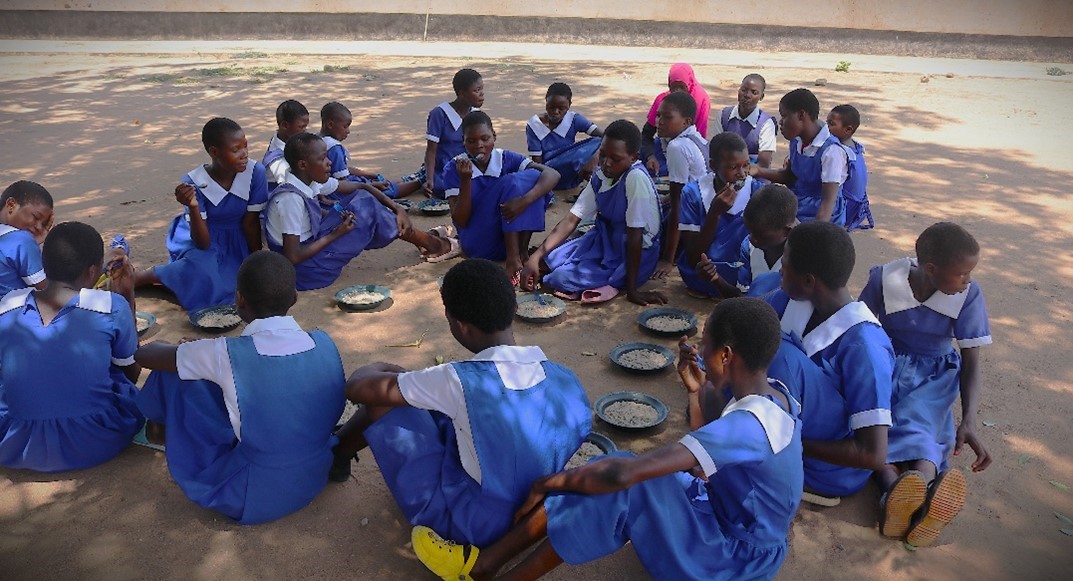
Charity and other students at her school enjoy their hot breakfast meal. Using biogas to cook meals is ensuring learners start their classes on time. Photo credit: WFP/Patricia Cepeda
This relief from the project is noticeable throughout the school and benefits everyone, including the students. "When the cooks were using firewood, we often started our classes late and had to stay longer to finish our lessons," recalls Charity, a 16-year-old student at Mtowe. Charity is happy that they now receive their breakfast on time. " With the biogas used for cooking, we eat early and are ready for classes by 7:30 a.m.," she says with a smile.
Malawi is grappling with significant environmental and energy challenges and rampant cutting down of trees for firewood. About 98 percent of households depend on biomass, resulting in habitat loss, soil erosion, and increased carbon emissions.
In the Chikwawa district, biogas is making a difference in 10 schools, providing planet-friendly meals to over 9,500 students. Welford Chizumeni, headteacher at Mtowe School, notes that due to scarcity of firewood, local cooks previously had to travel far for to fetch firewood. "We are grateful that this biogas project was introduced at our school, allowing local communities to also learn about its environmental benefits and create opportunities to explore other affordable biogas technologies that can be used at household level," says Mr. Chizumeni. Parents and cooks bring dry cow dung to school three times a week to support the initiative. This cow dung is fed into biodigesters, which convert the organic waste into biogas and biofertilizers through anaerobic digestion.
Mr. Chizumeni noted that the school will use the biofertilizer in their nutrition garden while they explore a partnership with local farmers to exchange cow dung for biofertilizer. This will ease the burden on cooks and parents while fostering partnerships with the local communities.
The efforts in the Chikwawa and Kasungu districts align with Malawi’s broader transition to clean cooking, as outlined in the Malawi e-Cooking Roadmap by the Ministry of Energy in March 2024. The roadmap highlights the urgent need for alternative cooking solutions, given that over 90% of Malawi’s household energy consumption still relies on unsustainably sourced biomass. School meals represent 70% of all publicly managed food systems and are the second largest consumers of biomass energy after households. Their reach and scale make them a powerful entry point for governments to reduce food-related emissions through policy change. As momentum builds, Malawi’s pilot could serve as a blueprint for other nations in the School Meals Coalition and beyond, demonstrating how school meals programmes can integrate clean energy solutions for greater long-term impact.