

In a recent interview, Honourable Ntoi Rapapa explained why the government is investing in Lesotho's home-grown school feeding programme. Photo credit: Lesotho News Agency
By Tsitsi Matope
Honourable Ntoi Rapapa, Lesotho’s Minister of Education and Training, highlights the remarkable progress of Lesotho’s national home-grown school feeding programme since joining the Coalition. Its membership has connected Lesotho with the Coalition Initiatives and key partners like the Global Partnership for Education, mobilizing technical assistance to implement Lesotho’s national commitments.
The School Health and Nutrition Technical Assistance Facility, a Global Partnership for Education initiative supported by the World Food Programme, will align school nutrition initiatives with the country’s broader education goals. This facility will play a crucial role in the rollout of the 2024 National School Feeding Policy, emphasizing a series of actions aimed at enhancing the programme quality. Lesotho is enforcing policies to procure 80% of school food from local farmers, aiming to increase the school meals budget by 50%, and conducting a Value for Money Study to assess the sectoral costs and benefits of school meals to support programme strengthening. These advances in Lesotho showcase how countries can forge significant partnerships through the School Meals Coalition to create more sustainable, home-grown programmes.
Q: You have been appointed Minister of Education and Training three times. Throughout your tenures, you have championed school meals and advocated for partnerships to develop a more sustainable programme. Why are you so passionate about school meals?
A: Growing up in the Berea district my three siblings and I were all in primary school simultaneously, and it was a real struggle for my mother to afford lunch packs for all of us. The school meals we received made a huge difference for our family. They helped us focus on our education and allowed my mother to save money for other essential items like books and uniforms.
In high school, parents paid a minimal fee to support the provision of school meals. This model was good because it enabled the government to extend school meals to secondary and high school students. Whenever I talk about school meals, I can't help but reflect on my school days and wonder how we would have coped without the food we received at school.
Many people underestimate the power of school meals and the very real worry of a child who leaves home with no food, knowing there will be nothing to eat at lunch break. Such a child cannot perform well in their studies. While we all need food to function, ensuring that our children's education is not compromised by hunger is even more crucial. Children are our future, and that is why I must do everything I can to support their education so that they continue to advance Lesotho when they become adults.
Q: The national school meals programme has evolved in several ways; can you share some insights on the key shifts highlighting why these changes are important?
A: The programme has evolved through various models, including those from the WFP, Catering Services, and National Management Agents (NMA), leading to the recent inception of the home-grown school feeding model. The government and our partners are currently intensifying efforts on this new model because it allows us to collaborate with smallholder farmers, local communities, various ministries, and the private sector and create opportunities to enhance the entire food system.
This shift aligns with our national commitment to school meals through the School Meals Coalition, where we pledge to source 80% of our food from local smallholder farmers. We are also investing in mechanisms to improve the quality and nutrition of school meals, supporting the efforts of our allies in the Ministry of Health.
That is why we are excited about our new pilot initiative, the School Health and Nutrition Technical Assistance Facility, in partnership with the Global Partnership for Education and the World Food Programme. This pilot will help build government capacity to enhance the quality of the programme and align school nutrition initiatives with our broader national education goals.
We will focus on five key priorities: Sustainable financing, Strengthening policy and legal frameworks, Coordination, Menu improvement and Mapping smallholder farmers for partnerships. I must say that the highlight of this initiative is its multisectoral approach, which will deepen the understanding among stakeholders that the school meals programme is everyone's business. It's about food production, water, energy, nutrition, health, and the entire economy.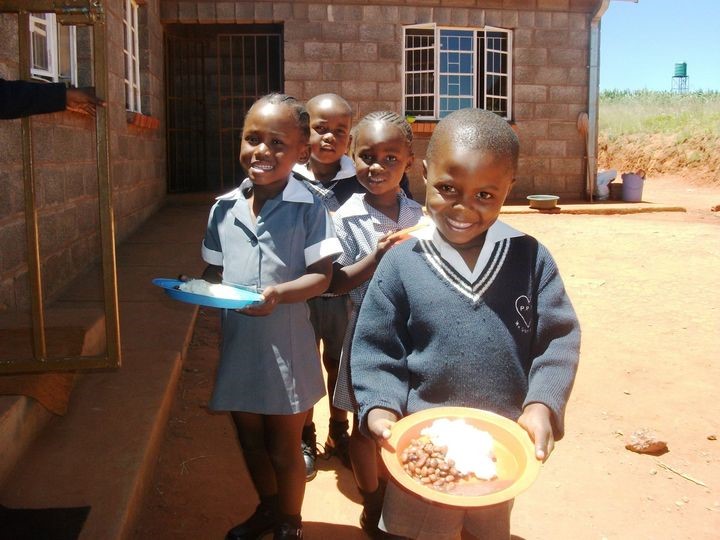
Children at St. Ambrose Primary School collect their lunch meals served on each school day as part of Lesotho's national home-grown school feeding programme. Photo credit: WFP/Lesotho
Q: Many African governments are prioritizing school meal programmes in their national budgets; how ambitious is the Government of Lesotho in ensuring more funds are allocated to the programme? What actions are you taking to develop a more sustainable home-grown school feeding programme?
A: Our national programme is universal and fully funded by the government at the primary school level, reaching children aged between 6 and 13. Through the GPE-funded Technical Assistance Facility, we will prioritize interventions to improve sustainable financing using a multisectoral approach. This strategy will help us gain new advocates for school meals from other ministries, such as Finance and Development Planning.
We are currently leading the Value for Money study, which will help us to assess the comprehensive sectoral costs and benefits of school meals, supporting programme strengthening. We will use this assessment to bolster our resource mobilization and galvanize support from various sectors.
Our ambition in financing is captured in our national commitment under the School Meals Coalition. The government has pledged to increase the school meals budget by at least 50% to cover rising costs per meal over the next three years. For example, last year, the government increased the school meals budget from M3.54 (Maloti) to M5.54 per child/day (approximately US$ 0.20 to US$ 0.31) to cover additional costs.
Developing a more sustainable programme is at the heart of our efforts, and for this to happen, we need the support of local communities. We have established and trained Community School Feeding Committees to prioritize community involvement in school meals initiatives. Their engagement will facilitate the developments and innovations we aim to see happening at the local level, including working with farmers to influence the production of diverse crop varieties, building relationships with local businesses and the private sector participation in initiatives like food fortification.
Q: You have spoken a lot about including traditional or other staple foods in school menus. Why is it important for school meals in Africa to be adapted to local diets?
A: This is a crucial agenda for Lesotho and the rest of Africa – we must feed our children and ourselves the food we grow! It’s essential to create sustainable, nutritious diets that are consistent, ensuring that the staple foods children enjoy at home are the same ones they find on their school plates. By embracing traditional foods, we can revive and preserve the nutritious staples we are gradually losing, such as small grains, wild fruits, some vegetable varieties and roots. This approach not only supports our children’s health but also strengthens our cultural heritage.
In Lesotho, we have a variety of local foods, including the delicious setampo/mohlala (samp), which is coarsely ground corn that can be served with mixed vegetable soup; mokopu (pumpkins); and motoho, our famous traditional, non-alcoholic fermented drink made from sorghum. These foods are familiar to the children and will excite them when served at school. They are not only delicious and nutritious but also affordable and easy to cook.