
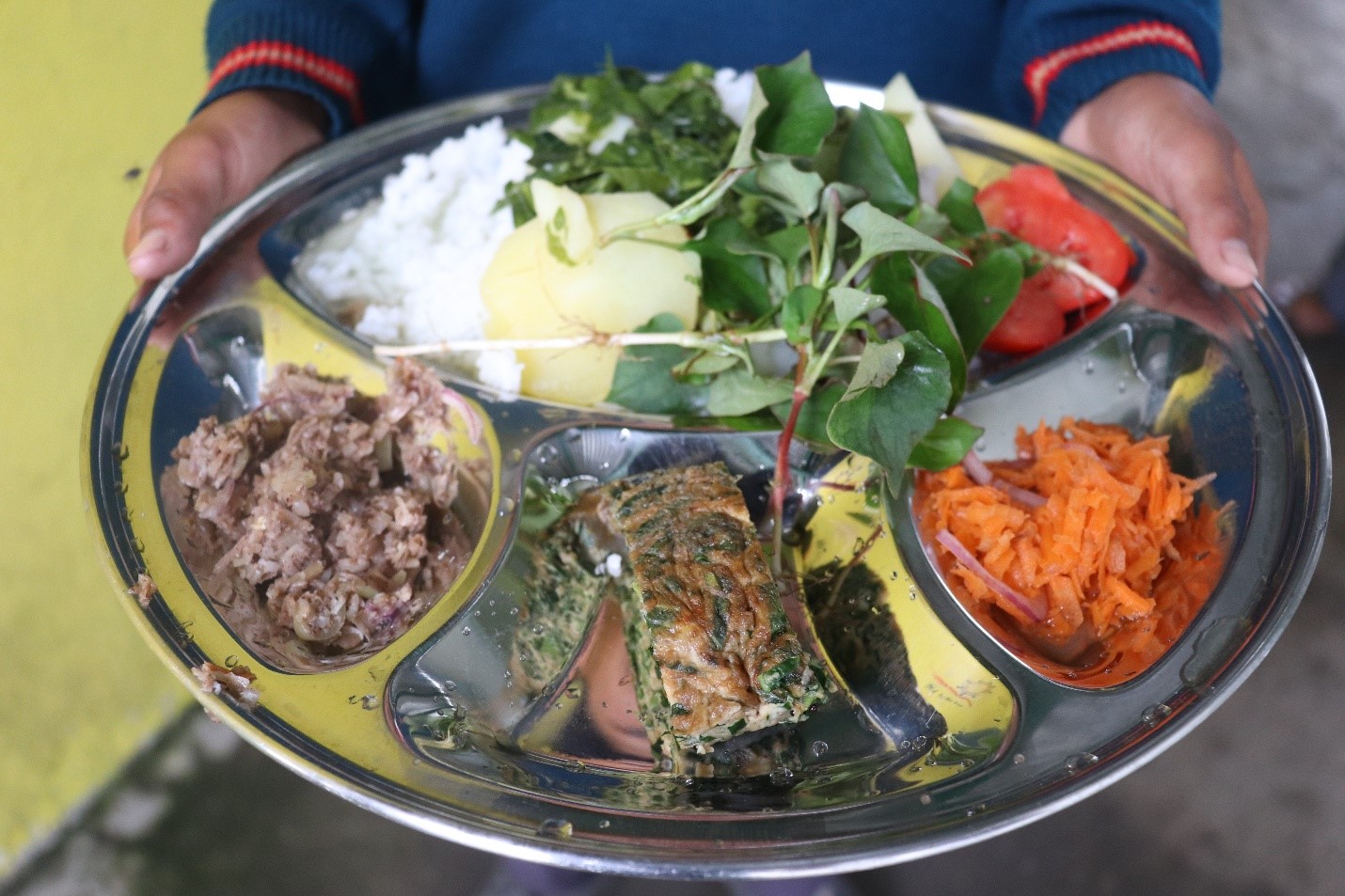
A school meal plate served at Laitshohpliah RCLP/UP School featuring mashed potatoes, wild banana flower with perilla seeds, grated carrots, omelette with local wild edible Jakhria and fish mint. ©NESFAS / Antony Lyngdoh
A nutrition project promoting local diets, funded by a partner of the School Meals Coalition improves the quality of school meals in Northeast India
The aroma of freshly prepared food fills the kitchen at Laitsohpliah RCLP/UP* school in Meghalaya, Northeast India, as children eagerly queue for their meals. Today’s menu includes a warm serving of rice, banana flowers with perilla seeds, grated carrots, an omelette prepared with jakhria- a local wild edible plant, and fresh jamyrdoh (fish mint) leaves. This meal is a powerful example of how community-driven initiatives combining Indigenous knowledge, local biodiversity and innovation can come together to improve children’s health and nutrition.
In 2022, the Northeast Society for Agroecology Support (NESFAS) launched the 'Linking Schools to Agrobiodiversity for Improved Diets, Nutrition and Livelihoods' (hereafter referred to as ‘Linking Schools to Agrobiodiversity’) project across 11 schools in Meghalaya. The project is funded by a partner of the School Meals Coalition: The Indigenous Partnership for Agrobiodiversity and Food Sovereignty (TIP) and the Indigenous Peoples' Food Systems Coalition. TIP partners with grassroots organizations to enhance the nutritional quality, diversity, and sustainability of school meals by leveraging local agrobiodiversity intricately linked to Indigenous Peoples' food systems. Grounded in local ecosystems and a deep, harmonious connection with nature, Indigenous Peoples' food systems have long provided nutritious diets in diverse environments worldwide.
Undernutrition Amid Rich Biodiversity
The ‘Linking Schools to Agrobiodiversity’ project builds on India's PM POSHAN scheme (previously Mid-Day Meal Scheme), the world’s largest school feeding programme. While comprehensive, the programme struggles with significant challenges, including insufficient funding to ensure each child receives a diverse diet and to fill the gap in addressing micronutrient deficiencies.
Meghalaya, home to the matrilineal Khasi, Jaintia, and Garo Peoples, lies within the Indo-Burma Biodiversity Hotspot. A participatory mapping of agrobiodiversity undertaken by NESFAS revealed an average of 202 edible plants still cultivated, foraged, and consumed by these communities. However, despite this rich biodiversity, malnutrition remains a significant concern within local communities, particularly undernutrition among children. A 2017 study by McGill University found that 31% of children in Meghalaya were underweight, with 57% stunted and 10% wasted. Further, their nutrient intakes were below recommended levels, with anaemia and vitamin A deficiencies affecting 68% and 59% of children respectively. Subsidized staples from the national food welfare programmes, combined with market dynamics that make culturally inappropriate foods readily available, have contributed to the decline of diverse traditional diets, undermining Indigenous food knowledge and exacerbating nutritional challenges.
Recognizing the potential of Indigenous Peoples’ food systems, since 2019, NESFAS has implemented over 800 interventions as part of a nutrition campaign to promote diverse diets using locally sourced foods. Aligned with FAO's Minimum Dietary Diversity guidelines, the interventions have focused on building capacity, facilitating peer learning, encouraging intergenerational knowledge exchange, and creating locally tailored Information, Education, and Communication materials, which include posters highlighting the 10 food groups, recipe books and cooking demonstrations- all available in local languages. This aims to enhance the promotion of local diets. The nutrition campaign has helped NESFAS foster strong relationships with local communities, providing a solid foundation to successfully implement the ‘Linking Schools to Agrobiodiversity’ project.
Linking Schools with Agrobiodiversity
Under the ‘Linking Schools to Agrobiodiversity’ project, NESFAS partnered with Indigenous Peoples’ communities and schools to co-develop sustainable solutions to enhance the quality of school meals (see Figure below). A defining feature of the initiative was the decision to include wild edible species alongside locally grown, nutrient dense, underutilized crops.
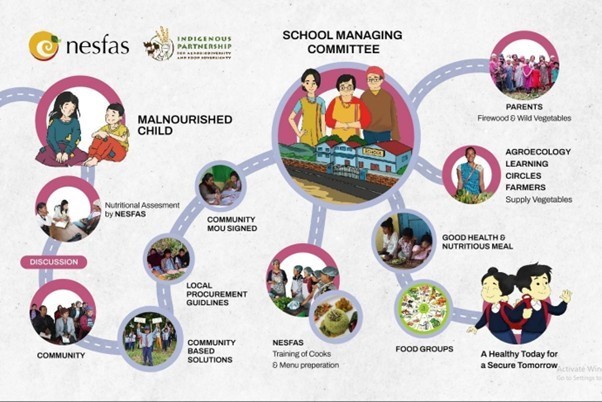
A community-Led School Meal Model Initiative, Illustrated by Blendink ©NESFAS
Community focus group discussions engaging Agroecology Learning Circle (ALC) members, farmers, parents, teachers, and cooks helped prioritize local food plants and create seasonal availability calendars detailing the optimal months for planting (when applicable) and harvesting. Local chefs and nutritionists trained cooks to create school meal menus and recipes that incorporate wild edible species and local biodiversity recipes that could easily be replicated in family cooking by, for example, adding wild edible plants to an omelette).
Community-driven school procurement guidelines were developed to encourage local sourcing. These guidelines highlighted the importance of prioritizing local food crops while motivating local farmers to adopt sustainable agroecological practices. By ensuring fair pricing and transparency in purchasing, the initiative supported local agriculture and helped circulate economic benefits directly back into the community. This collaborative approach emphasized the power of co-development in fostering stronger, more sustainable local food systems.
As part of the 'Linking Schools to Agrobiodiversity’ project, school gardens were expanded to grow crops from underrepresented food groups such as dark green leafy vegetables, pulses, vitamin A-rich fruits and vegetables. Common wild edible species such as water celery (Oenanthe javanica) and Nepal gynura (Gynura nepalensis) were also selected for domestication in both school and home gardens.
Transformative Impact
The project’s success can be largely attributed to the enthusiastic participation of parents, who generously provided fresh produce from their gardens and foraged for wild edibles. “Our community has always known the value of local foods,” said Rosetta Khonglam, a parent and community member. “We just needed guidance on incorporating them into school meals.”
The results were remarkable. In terms of promoting dietary diversity, there was a significant increase in the inclusion of green leafy vegetables (59%), legumes (43%) in school meals. Plates that once consisted only of rice, lentils, and egg now feature a vibrant colourful mix of ingredients such as millets, wild greens, and seasonal fruits. “The children love the variety, and we’ve noticed them growing healthier and becoming more energetic,” shared a school cook, Mrs. Bibi Flora Teron. Indeed, a year after the project began, nutritionists conducted an anthropometric assessment revealing a 30% rise in the proportion of children at a healthy weight. Data collected from various schools across the Khasi Hills, Ri Bhoi, and Garo Hills showed that most students were healthy, with over 92% maintaining a healthy weight. A teacher at Khliehumstem Presbyterian UP/LP School added that knowledge of wild edible species and the significance of dietary diversity has extended beyond the school, with families increasingly incorporating these foods into their daily diets.
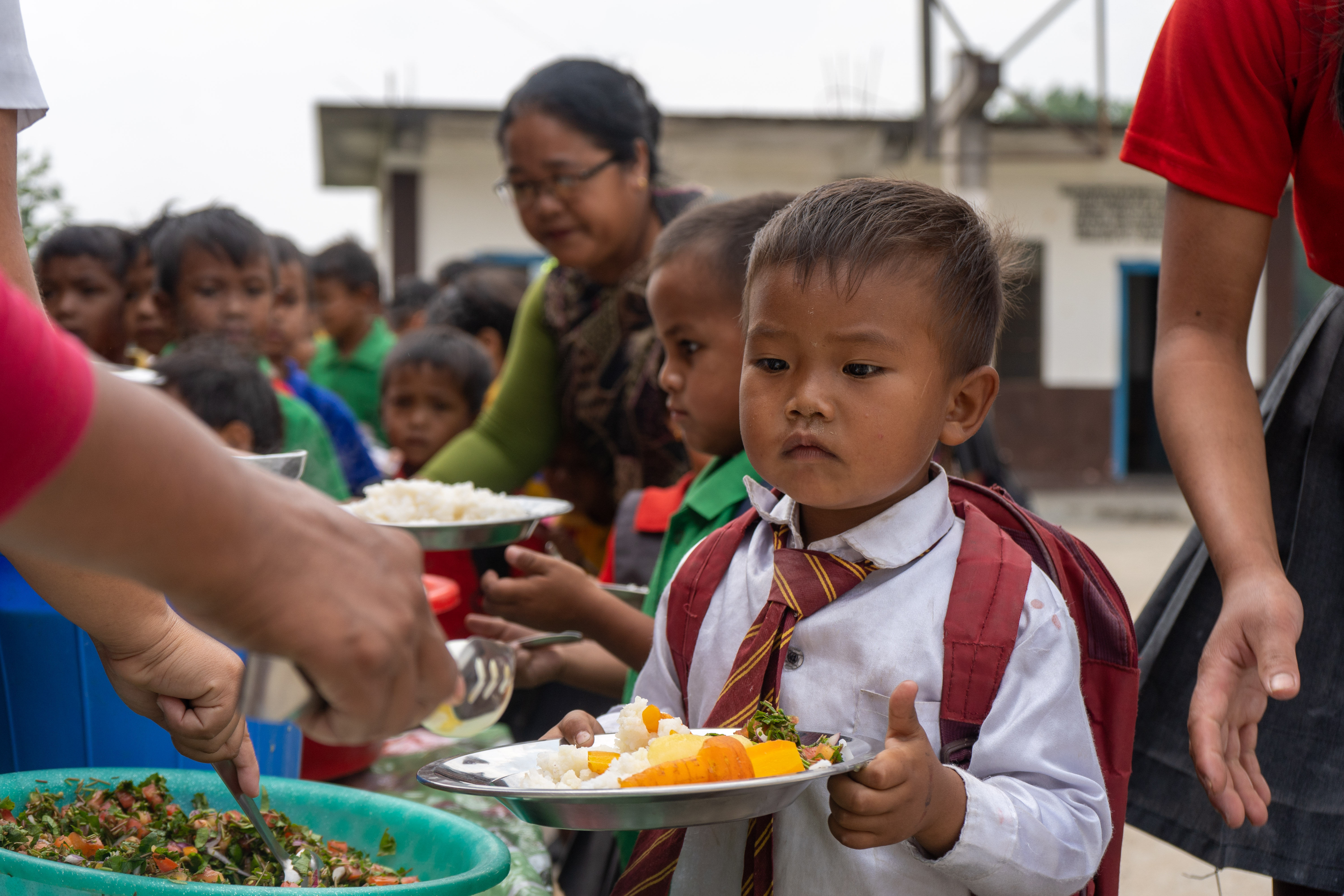
Students of Khliehumstem Presbyterian LP/UP School collect their freshly prepared school meals © NESFAS/ Banteilang Syiem
This initiative uplifted the livelihoods of 120 farmers by encouraging local procurement and purchasing wild edibles they harvested. By incorporating climate-resilient crops like millets and a variety of wild edibles into school meal programs, the “Linking schools to agrobiodiversity” project has fostered more diversified farms, bolstered agrobiodiversity, and empowered communities to build food systems that can withstand climate challenges. Through direct collaboration with farmers, the initiative reduced reliance on external supply chains, minimizing transport needs and cutting environmental impacts.
The Path Forward
The community's active involvement with the Dorbar Shnong (Village Council) has ensured the long-term success of the project. By mobilizing funds and pooling resources, the council has secured the provision of nutritious school meals, fostering shared responsibility and community ownership of children's nutrition and well-being.
Building on lessons learned, NESFAS, supported by the UN-IFAD's Indigenous Peoples Assistance Facility, has expanded the project’s model to five additional schools (bringing the total to 16 schools) to create healthy, sustainable food systems that conserve biodiversity, build climate resilience, and improve nutrition and livelihoods. Partnering with the Directorate of School Education and Literacy, NESFAS has trained about 7,000 PM POSHAN cooks cum helpers across Meghalaya. “This initiative aims to inspire modifications in the Mid-Day Meal programme to better meet the dietary needs of Indigenous communities,” said Bah Pius Ranee, Executive Director, NESFAS. With a vision to ensure healthy school meals to 1,000,000 children by 2030, NESFAS remains steadfast in its commitment to innovation and collaboration. These efforts demonstrate how a simple meal can become a beacon of health, resilience, and hope, reminding us that it takes a collective effort, from every corner of the community, to raise and empower children.
Learn more about NESFAS’s work here: In this episode, NESFAS connects with the Education Department, Government of Meghalaya, to discuss the impact of their Community-Led School Meal Initiative on improving student nutrition, while promoting sustainable food systems, biodiversity, and climate resilience.
This article was co-authored by Gratia E. Dkhar, Badarishisha Nongkynrih, and Pius Ranee of NESFAS, with collective support from the wider NESFAS team, and Sharon Mendonce and Teresa Borelli of the Alliance of Bioversity International and CIAT
Cover photo credits: ©NESFAS / Antony Lyngdoh
*Roman Catholic Lower Primary/ Upper Primary School