
By Tsitsi Matope
The Government of the Republic of Guinea is taking significant steps to improve the quality of its national School Meals Programme, mobilising new partnerships within the School Meals Coalition and aligning developments in school meals with the country’s 10-year Education Programme (2020-2029).
Guinea recently developed its national commitments to school meals, sharing with the Coalition to enable connecting with other members and partners who share a similar vision. These commitments align with the country’s institutional reform process that started in 2021 and the Interim Reference Programme (PRI) 2022-2024, which aims to sustainably improve the population’s quality of life. One of the critical pillars supporting social and human capital efforts, Guinea wants to increase school meals investment by strengthening the policy and legal framework to extend coverage to rural areas, ensuring school meal ingredients are sourced from local smallholder farmers. “Our commitments underline our ambitions to improve the quality and reach of school meals by increasing funding through the national budget in the next five years while supporting local farmers to sustain supply of fresh and healthy food,” said Honourable Ismael Nabe, Minister of Planning and International Cooperation in Guinea.
Being a country that understands the importance of diverse agricultural production and its strong connection with school meal programmes, Guinea is exploring partnerships that can help build smallholder farmers' capacities and strengthen the whole value chain. With the buy-in of all government ministries to invest more in food systems, Guinea is optimistic that smallholder farmers will be able to deliver over 70 per cent of food, such as rice and vegetables, to the national programme in the next five years. “As of 2020, our school meals budget has enabled us to provide nutritious meals in 401 primary schools while our partner, the World Food Programme, is managing 1,216 primary schools, and together we are reaching over 209,000 children across the country.”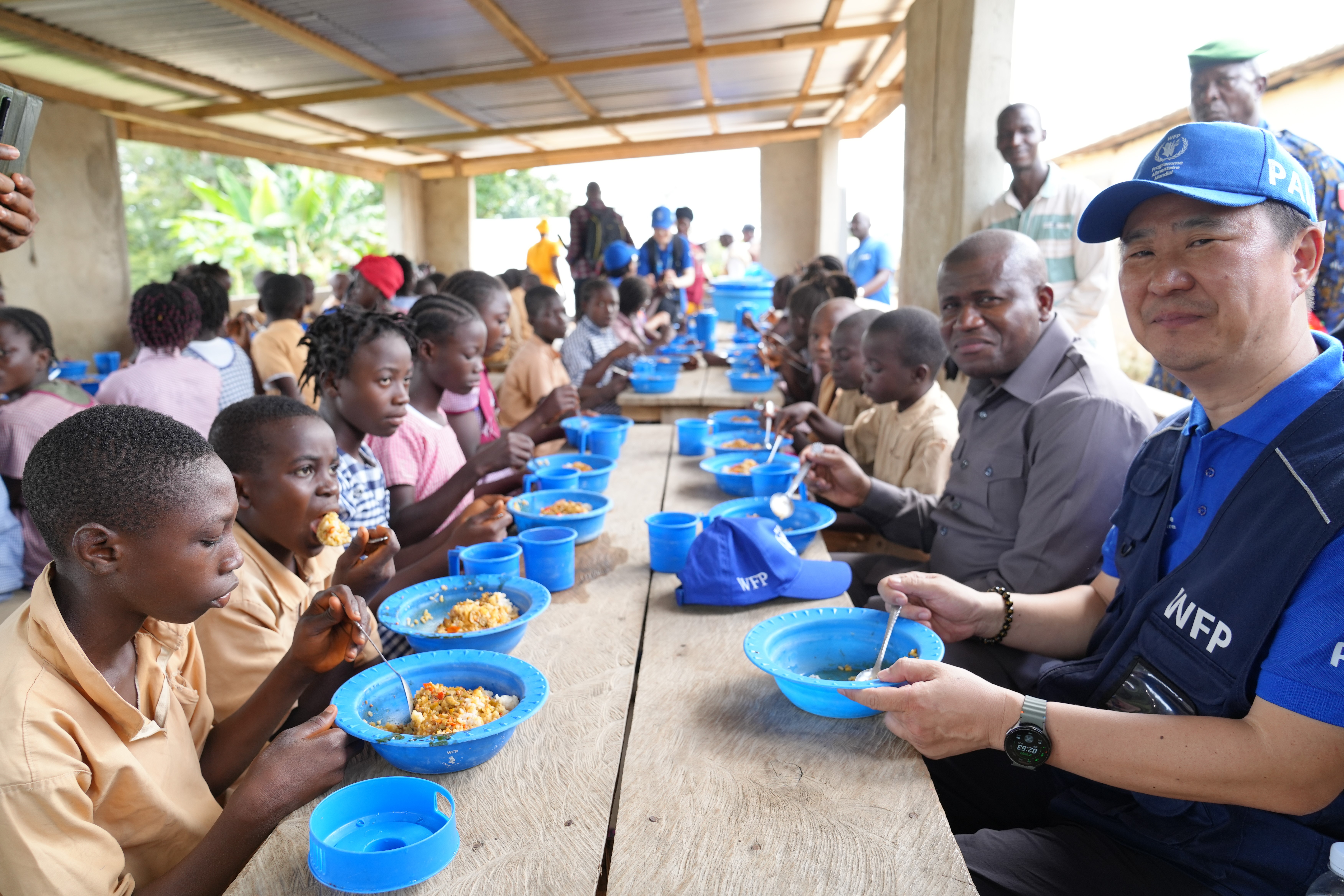
The programme ensures children can access healthy diets, improving their physical and cognitive development and learning, while encouraging girls and those from food-insecure families to stay in school. “It's extremely important for us to capitalise on the advantages of school meals looking at short to medium and long-term benefits. We have no plans to discontinue channelling resources to the programme because it guarantees a better future for our country,” said Minister Nabe. The ability of school meals to contribute to social and economic development efforts and the Coalition’s capacity as an enabler of global partnerships has emboldened and encouraged the government’s positive attitude towards the programme.
“We are humbled by the partnership opportunities we can utilise within the Coalition, particularly looking at the prospects within South-South and Triangular Cooperation. We are positioning ourselves to host the International Institute for the Development of South-South and Triangular Cooperation headquarters. This Institute will help developing countries, particularly Least Developed Countries, to achieve their individual and collective autonomy, as well as their sustainable and inclusive development in a context of change and crises. Initiatives support countries in capacity building in terms of research and training in all areas of South-South and Triangular Cooperation.” These initiatives, he added, can also help improve coordination and facilitate the exchange of successful experiences and innovation that has worked in various countries and at regional and continental levels. As a member of the Economic Community of West African States (ECOWAS) and the African Union, both of which are part of the School Meals Coalition, he noted that Guinea is looking forward to initiatives that can facilitate the sharing of lessons and strategies at the regional-to-regional level. Such exchanges, he explained, can support both regional and country development efforts in school meals while supporting the government to achieve its objectives under the Vision 2040 Social Development and Economic Plan.