
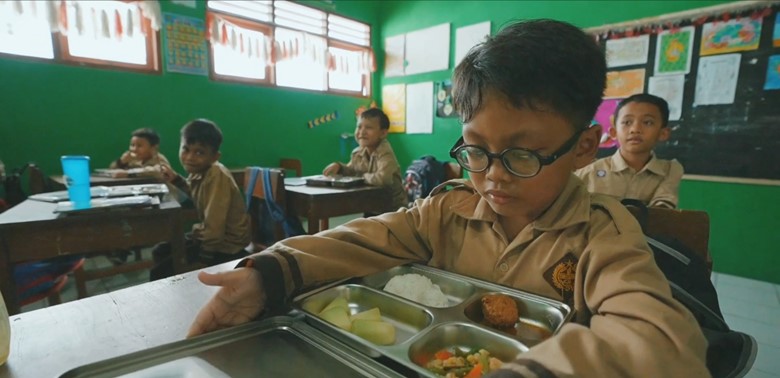
Students have their lunch meal prepared under a school meals programme integrating food waste management principles in Sleman and Bantul Regencies of Indonesia. Photo credit: IFSR/ Indonesia
PT Sarihusada Generasi Mahardhika (SGM), in partnership with the Indonesia Food Security Review (IFSR) and the Yayasan Pembangunan Citra Insan Indonesia (YPCII), have launched a groundbreaking Nutritious School Meal Programme in Sleman and Bantul Regencies, Yogyakarta Special Region in Indonesia. This programme uniquely incorporates food waste management principles, setting a new standard for sustainability and nutrition in school meal programmes in the country.
The programme is set to revolutionize early childhood education and health in Indonesia, engaging 2,149 young learners across 15 educational institutions, including Playgroups, Early Childhood Education Centers (PAUD), Kindergartens, and Elementary Schools. It also marks a significant leap forward in enhancing health and educational outcomes for young children, guaranteeing that they receive the essential nutrition they need for optimal growth and development by supplying pasteurised milk directly from Danone Indonesia to these schools.
The programme has so far worked with 1,000 parents and 200 teachers, providing them with education on zero-waste management, health and nutrition. Spanning three months, the programme was rolled out in four phases with the first two phases benefitting 730 students and 1,419 for the last two phases.
Muhammad, a 12-year-old student from an elementary school in Bantul is happy to eat at school and says the quality of meals is impressive. "Eating at school is improving concentration on my studies. After working hard in class in the morning, I look forward to my lunch meal because I know the food will give me energy to focus on my afternoon classes," says Muhammad.
What sets this programme apart is its dedication to food waste management principles, aiming to minimize environmental impact. All waste, whether from packaging or food leftovers, is meticulously managed to create value-added resources, showcasing a commitment to sustainability.
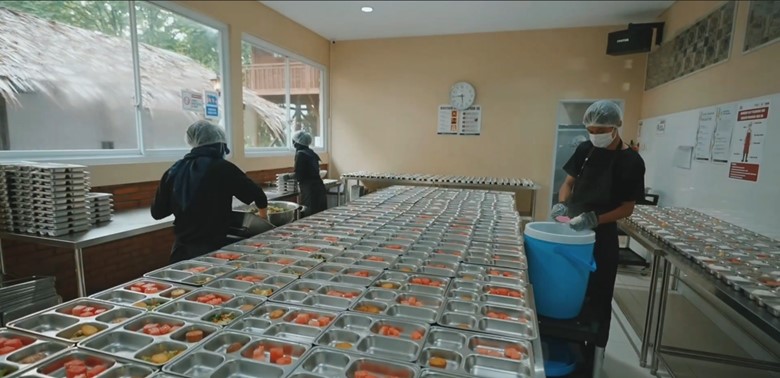
Serving meals at a school in Bantul: After the children have eaten, these workers collect all leftovers, and use special containers to dispose the food waste into the soil to make compost. Photo credit: IFRS/Indonesia.
The zero-waste concept in this programme employs the innovative LOSIDA (Lodong Sisa Dapur) practice, an organic waste management system that transforms food waste into compost using specialized containers. These containers, 120 cm long pipes, are used to dispose of food waste directly into the soil, enriching it and benefiting school gardens and other plants like trees in and around schools.
This programme results from a strategic collaboration between IFSR, SGM, and YPCII, demonstrating a shared commitment to transformative improvements in health and education. The structured and comprehensive approach aims to enhance the well-being of children in Sleman and Bantul and to serve as a scalable model for other regions in Indonesia.
Aligned with the National Food and Nutrition Action Plan (2025-2029) of the Republic of Indonesia, which emphasizes strengthening food security and nutrition, the programme also aims to achieve sustainable improvements in child nutrition and health outcomes. By raising awareness on the importance of nutrition, effective handling and management of food waste and environment protection, this programme contributes to Indonesia's long-term goals aiming to use school meals to improve children's health, their learning and develop healthy eating habits.