
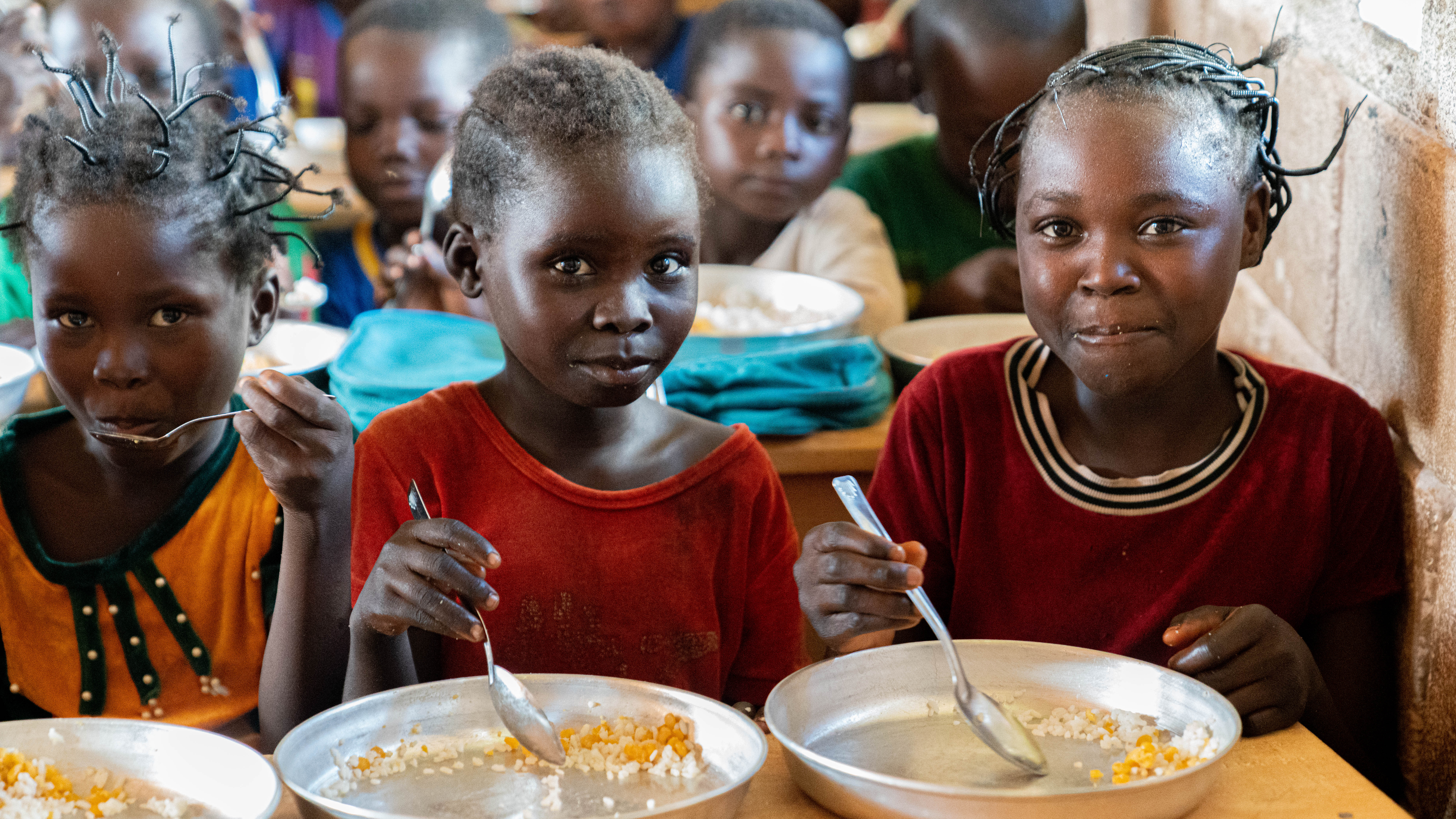
Learners at a school in the Central African Republic have their lunch meal through a school meal pilot in northwest Paoua area near the border with Chad. Photo credit: WFP/Marie Dasylva
By Bruno Djoyo
The Government of the Central African Republic (CAR) will host the 10th Africa Day of School Feeding celebrations from 28 February to 1 March in the capital Bangui. Held under the theme: "A Decade of Nourishment: Celebrating the Past, securing a Just Future," representatives from government and development partners will push for actions that further scale up quality school meal programmes across Africa. Celebrations will align with the African Union's broader goals to create sustainable, inclusive, and resilient programmes and ensure the transformation of food-systems that promotes access to healthy diets, support equitable livelihoods, and contribute to environmental sustainability.
The host country's President, H.E. Faustin-Archange Touadéra, has put the country’s national school feeding programme on a progressive path, demonstrating a continued commitment to expanding the reach and quality of school meals. As a champion for locally sourced school meals, President Touadéra will officially launch the 10th-anniversary celebration alongside Felix Moluoua, Prime Minister of the Central African Republic.
Last year, President Touadéra launched the National Home-Grown School Feeding Programme to boost local food production and provide safe, nutritious meals to 450,000 children in 575 schools by 2027, up from the current 170,000 children in 192 schools. He emphasized the life-changing power of these programmes in supporting the education of girls and boys, health, and nutrition, and forging progressive partnerships. “As we expand the programme, we need to develop stronger partnerships that can support our efforts to enhance national technical capacities, allowing us to deliver fresh, diverse, and nutritious meals in schools.”
At a recent back-to-school event in Bambari, President Touadéra stated his government has created a dedicated line in the state budget to extend school meals. “We have also established a National School Meals Department and adopted a plan to scale up the programme to reach all children, including those in areas difficult to reach. As we flex our muscles to ensure the well-being of our children, we are also excited to be part of the School Meals Coalition. I have no doubt that through knowledge exchanges, we are going to improve the quality of our school meals and contribute to the development of sustainable programmes in Africa,” President Touadéra said.
School meals play a crucial role in guaranteeing adequate nutrition and health of children in the Central African Republic. Roughly nearly two million people, a third of the country’s population is facing acute hunger, according to the latest Integrated Food Security Phase Classification findings. This food insecurity is attributed to poverty, inability of many farming families to adapt to extreme weather events and armed violence, which over the years has disrupted supply chains and displaced hundreds of thousands of people. Many of these challenges do not only affect CAR. According to the World Bank, 8 out of 10 children under the age of 10 in Central and West Africa cannot read a simple text. Furthermore, while over 22.4 million children in Central and West Africa benefited from school meals in 2022, more than 32 million remain out of school—the highest number in any region worldwide.