
 At the Maximizing the Nutrition Impact of School Meal Programmes event, the School Meals Coalition Coordinator, Ms. Emilie Sidaner interviews Dr. Sok Silo on Cambodia's efforts to improve the nutritional quality of school meals. Photo credit: FAO/Rome
Following a bold move to host the 2024 School Meals Coalition Summit, Cambodia is leading efforts to enhance school meal nutrition and boost human capital development efforts. In a Question and Answer session hosted by Ms. Emilie Sidaner, the School Meals Coalition Coordinator, H.E. Dr. Sok Silo, Secretary General of the Council of Agriculture and Rural Development, shared Cambodia’s journey in developing School Meal Nutrition Standards at the ‘Maximizing the Nutrition Impact of School Meal Programmes’ event co-organised by FAO, WFP, UNICEF and the UN-Nutrition Secretariat during the recent Nutrition for Growth Summit in Paris.
Q: The Government of Cambodia has shown strong commitment to providing nutritious school meals, especially through the efforts of the Ministry of Education, Youth, and Sports and its partners. Can you share the background of the ongoing efforts?
I just want you to picture this: imagine a nation where over half of the population is under 30, poised to shape the future in a world filled with uncertainties. Cambodia is that nation, and the Royal Government is determined to raise a healthy nation to drive sustainable growth. For us, failure is not even an option!
The government has recognized that poor diet quality is a major driver of malnutrition among pre and primary school children and this poses a threat to the country’s vision, and we have made dealing with this problem a priority. In 2016, a dietary assessment revealed alarming statistics: over 80% of children aged 6 to 17 years lacked essential micronutrients like vitamins A, B and C as well as calcium, and zinc. Nearly half also had insufficient protein and iron intake!
That is not all. Further studies showed that 87% of children consumed at least one unhealthy food item daily, including sugar-sweetened beverages and unhealthy snacks.
We know that these poor diets and malnutrition significantly impact children’s ability to learn and thrive. That’s why Cambodia has renewed its commitment to developing a quality school meal programme that advances education, nutrition, health and the economy.
Q: Can you tell us some of the measures you have implemented to address this problem of malnutrition among school-age children?
We are enhancing the national home-grown school feeding programme from multiple angles. By 2028, Cambodia aims to fully manage, finance and assume ownership of the programme, ensuring it addresses all forms of malnutrition among school-age children. The Government is very much open to new partnerships to further improve our home-grown school meals model. Our commitment is demonstrated through the new National Policy on School Meals (2024-2035), which guides strategic efforts and envisions nutritious school meals as key to strengthening human capital development.
The government has allocated a national budget to provide hot meals to over 300,000 children annually across 1,114 pre and primary schools. Prime Minister Samdech Hun Manet’s endorsement of the School Meals Policy increased the national budget from US$5.6 million in 2024 to US$7.4 million in 2025, raising the per-student allocation from 780 Riels (0.19 US$) to 820 Riels (0.20 US$) to ensure adequate meals despite inflation. This financial commitment has enabled transition of 65% of all school meals to national ownership this year.
It’s important to note our strong emphasis on the quality of meals, in terms of nutrition, adapting to Cambodia’s rapidly changing socio-economic and nutrition landscape. Developing School Meal Nutrition Standards and Guidelines has proven cost-effective in meeting evolving requirements. The partnership of the Ministry of Education, the World Food Programme and the Food and Agriculture Organisation is testing the global methodology to develop Cambodia’s School Meal Nutrition Standards.
Q: Other members of the School Meals Coalition are interested in the process you followed to develop the School Meal Nutrition Standards. Can you highlight some key steps they can learn from?
A key element of our process was multistakeholder consultations, which facilitated the sharing of ideas, lessons and best practices. We began with an inception workshop to shape our overall strategy. This was followed by five critical assessments to inform the preliminary School Meal Nutrition Standards. One significant assessment, the Baseline Dietary Assessment, revealed concerning trends, for example, we found that children's diets were dominated by cereals, mainly rice, with fruits and vegetables consumption far below the recommended levels. Additionally, snacks and drinks high in fat, salt, and sugar accounted for nearly 30% of children’s daily energy intake. Widespread nutrient deficiencies were noted, with many children not meeting adequate intake levels for vitamins A, B and C, as well as calcium, iron, and zinc.
Another study examined the school food environment and children's snacking behaviors, highlighting the high availability of unhealthy snacks and children's preference for them. The final multistakeholder workshop reviewed the preliminary standards and assessed their feasibility. In the spirit of South-South Cooperation, Cambodia is eager to share its experiences with other countries committed to investing more in nutrition to improve their home-grown school feeding programmes.
Q: How did you develop the Standards? Can you describe them and explain how you tested their impact?
We used key data from studies to define nutrient and food targets for the school meals, leading to recommendations for improving school meals acceptability. Assessment results were reviewed, and preliminary standards revised based on feasibility considerations. These standards were then translated into meal recipes, arranged into a two-week menu cycle. The main improvements include introducing fortified rice and adjusting quantities served to meet the nutritional requirements for different ages.
Vegetables portions increased from 50g to 80g, and animal protein enhanced from 20g to 30g, ensuring a better protein balance for growing children. A daily portion of 110g of fruit was introduced while oil and iodized salt quantities were not changed. For the first time, standards included caps on sodium and added sugar. Assessments revealed taste of food is crucial for students, so the improved meals included seasonings and more dry dishes preferred by children. After defining the new menus, a three-month pilot involving 40 schools was launched to test children’s response.
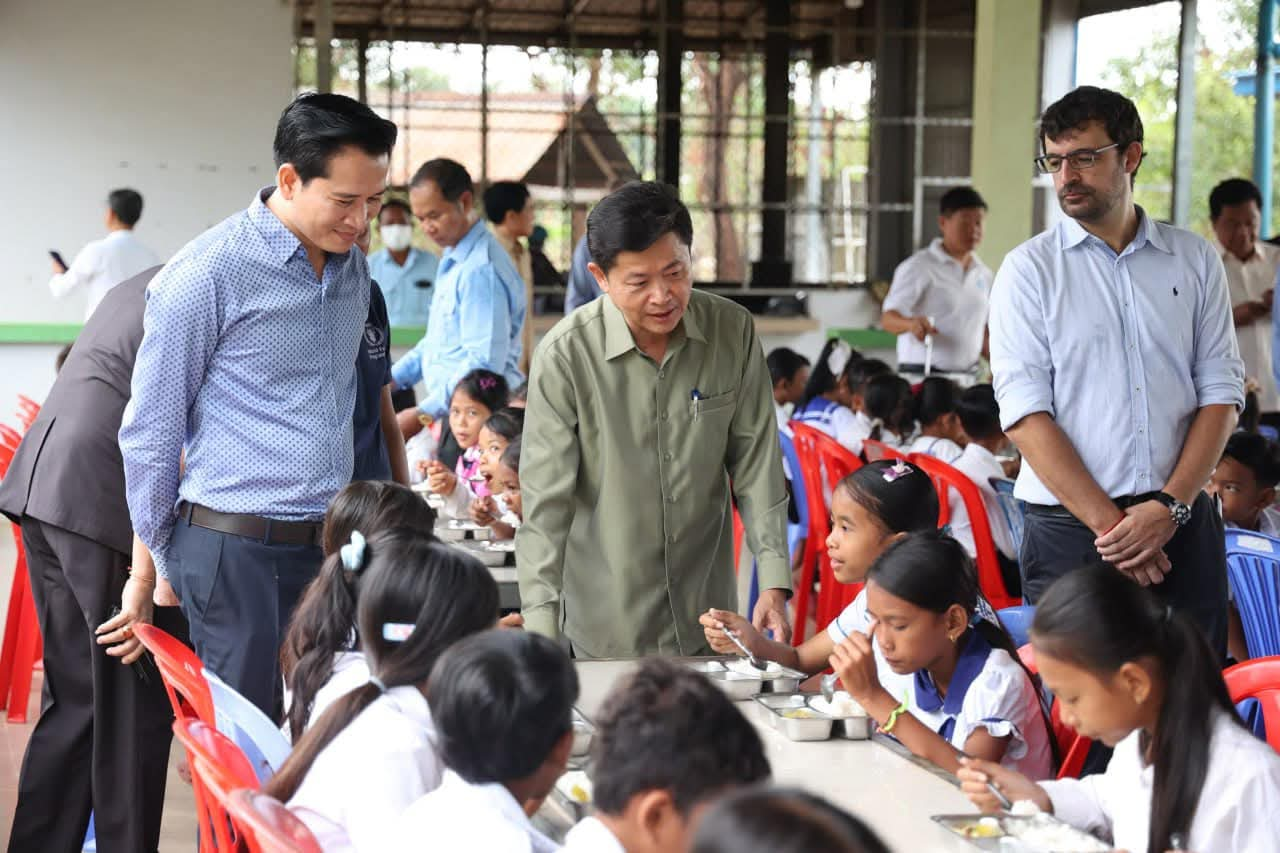
During a visit to one of the pilot schools for the new School Meal Nutrition Standards, Dr. Sok Silo interacted with some children during their lunch meals. Photo credit: WFP/Darapech Chea
Improved meals were provided in 20 schools, while students in the other 20 continued with usual meals to assess the impact on children’s diet quality. A Food Education Strategy was introduced in the 20 schools with improved meals to promote consumption and reduce unhealthy snacks. While trial results will be available later this year, observations indicate a positive reception, especially regarding fresh fruits.
Q: You are here in Paris for the Nutrition for Growth Summit. Take us through the next steps for school meals and nutrition?
So let me start by saying our efforts have significantly shaped Cambodia’s Nutrition for Growth Commitments, announced here in Paris. Back home, we are developing costing scenarios to explore options for gradually improving the nutritional quality of school meals. These improvements, which include more vegetables, protein sources and fruits, come at a higher cost. However, we also know that the benefits justify the investment, and we are exploring cost effective strategies and new partnerships for a full rollout by 2030.
A key step is the gradual adoption of fortified rice, a cost-neutral addition. With support from WFP and DSM-Firmenich, we aim to reach 80,000 school children with fortified rice by 2027. Our school meal commitment for the Nutrition for Growth Summit includes: Full government ownership of the National Home-Grown School Feeding Programme; Scaling up a complementary nutrition activity, including meal improvements per the Nutrition Guidelines and Standards, Water and Sanitation Hygiene, social behavior change and others; and Adding essential micronutrients to rice, fortification, a proven cost-efficient solution to address micronutrient deficiencies. We plan to develop an incremental adoption plan for the Nutrition Guidelines and Standards, ensuring that costs cannot triple overnight.