
By Tsitsi Matope
The Global Alliance against Hunger and Poverty, launched on 18 November at the G20 Leaders’ Summit in Rio de Janeiro, Brazil, has developed a ‘Policy Basket’ of programmes, policy instruments and six 2030 Sprints designed to reinforce the fight against hunger and poverty. Among those instruments are School Meal Programmes. The School Meals Coalition speaks to Brazil’s Minister of Development and Social Assistance, Families and Fight against Hunger, Honourable Wellington Dias, to share some insights on the role of school meals in supporting the Global Alliance to achieve its goal.
Q: What is the Global Alliance against Hunger and Poverty and why is Brazil’s G20 Presidency driving this agenda?
A: The Global Alliance is a practical mechanism to mobilize more financial resources, knowledge and technical support from where these are abundant and ensure they are channeled where they are needed most. The objective is to then use these resources to support the implementation of impactful actions, policies and programmes at national and global levels.
The Global Alliance has an innovative approach that allows for reduced transaction costs, flexibility and collaboration. For example, where we have members seeking development assistance or support to accelerate the implementation and execution of public policies, they can connect with partners willing to offer experience or financial support to advance these efforts. The model mobilizes and articulates different partners in the fight against hunger and poverty. In addition, it also offers risk mitigation as a “Policy Basket” of rigorously evaluated public policies and ensures that donor investments are directed to cost effective, and high-impact initiatives-
There is also an aspect of economies of scale and scope – by favoring the pooling of resources and expertise, the Global Alliance enables greater impact and efficiency than individual and fragmented efforts.
Some people may ask: why are we thinking this way? This is because, despite progress over the years, hunger and poverty remain persistent global challenges.
And so, some people may ask: why are we thinking this way? This is because, despite progress over the years, hunger and poverty remain persistent global challenges. We are still far from reaching Sustainable Development Goals on poverty eradication and zero hunger. To this day hunger still affects more than 730 million people worldwide and this is a great cause for global concern!
As we all know, when people are hungry, they are not productive so countries cannot develop, children cannot study, there will be no meaningful future to write home about, and on each day, people die due to hunger and malnutrition related ailments. This is an agenda that is so important because it speaks to life itself. And that is why President, Luiz Inácio Lula da Silva, during the Brazilian G20 Presidency, is championing and driving efforts to end hunger and poverty, not only in Brazil but the world over.
Q: School meal programmes are one of the policies in the Global Alliance’s Policy Basket and are among the six ‘2030 Sprints’ that will accelerate action in the next five years. Can you tell us why school meals are a critical investment in efforts to end hunger and poverty?
A: School meals are crucial because in many schools around the world, we have millions of children who depend on the only meal they eat at school. And it is for that reason we are also emphasizing, that school meals should have all the nutrients a child needs to thrive and perform well in school. School meals encourage the poorest families to send their children to school giving them a fighting chance to make it in life and break the intergenerational cycle of poverty. I would like to emphasize that school meals are indeed helping to keep girls in school in many countries, preventing them from marrying early and having children they will struggle to raise. When girls stay in school, we also make progress in bridging the gender gap. It means in future we will have more women leaders and in decision making positions!
…School meals are indeed helping to keep girls in school in many countries, preventing them from marrying early and having children they will struggle to raise. When girls stay in school, we also make progress in bridging the gender gap.
School meal programmes, particularly those that are home-grown, offer much more than nourishment to children. They also make communities more resilient, support national economies and foster social stability. The State of School Feeding Worldwide 2022 report, for example, tells us how school meals have created four million direct jobs in 85 countries. Now that is something that immediately gets the attention of the Global Alliance! What is even more interesting is this: it is mostly local women who are benefitting from the jobs created by these programmes.
With many benefits that countries can realize when they invest in school meals, we all need to rally around these programmes and extend them to reach all children by 2030. The Global Alliance partnerships are driving the 2030 Sprint for School Meals – to mobilize adequate funding and develop governments’ technical capacities to improve their programmes, make them more sustainable. We know it’s not going to be an easy road, but the Global Alliance will most certainly go all out in promoting policies such as school meals, to achieve our goal.
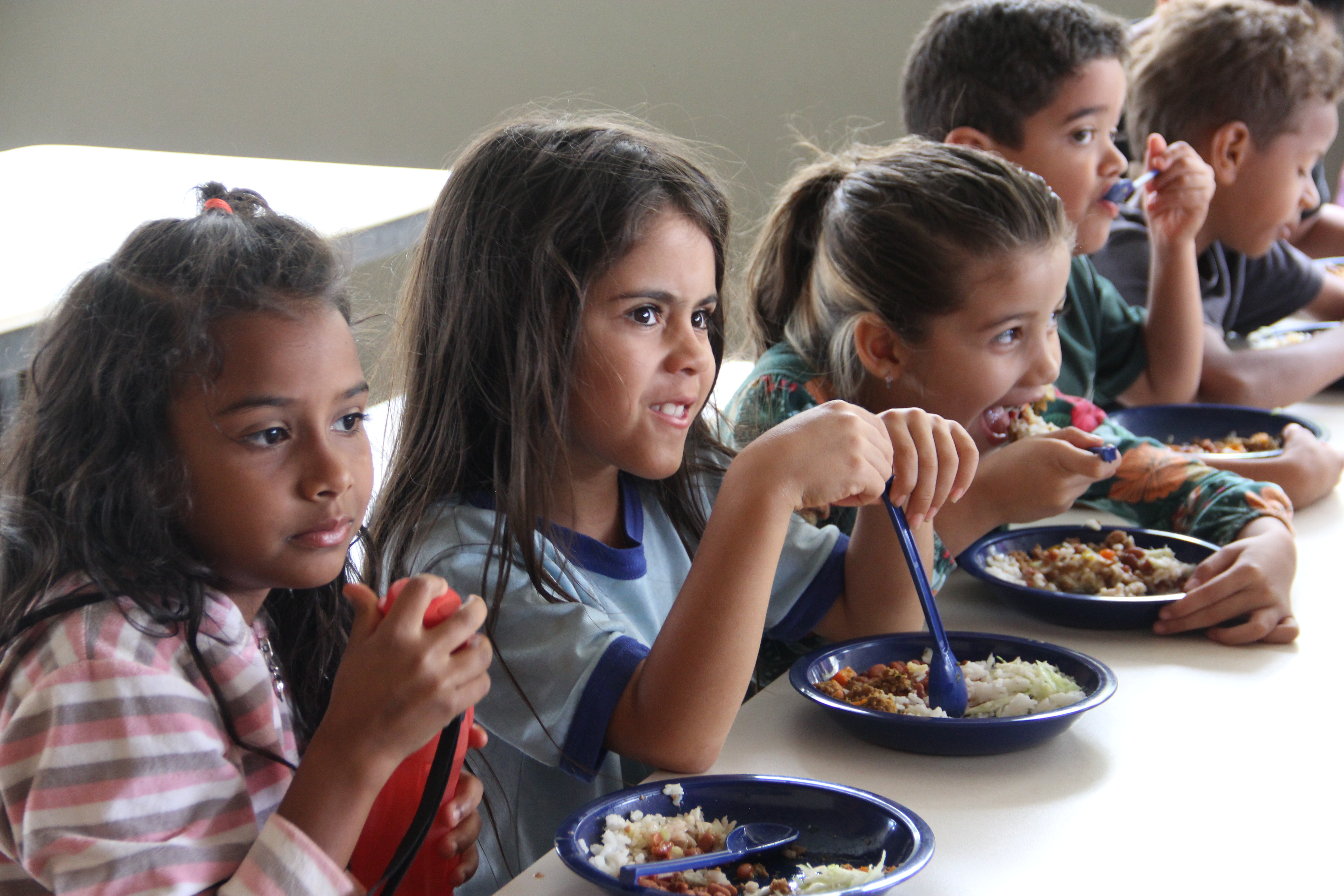
Q: Let’s focus on Brazil, how is the school meals programme contributing to the fight against poverty and hunger in your country?
A: I tell our story to highlight the importance of implementing robust public policies against hunger and poverty, and school meals is one of those effective policies. When we had a good range of interconnected programmes, with social participation and control, we were able to get out of the Hunger Map and reduce poverty to less than half of what it was in 2003. When these programmes were distorted, hunger returned, and poverty grew.
In this new term, President Lula has made a commitment to once again end hunger in Brazil, something we had already achieved in 2014. Since the beginning of the current administration in 2023, we have implemented a strategy to resume and coordinate more than 80 government programmes between various ministries, which were interrupted.
For example, our best-known programme, Bolsa Família, currently reaches 55 million people, more than a quarter of the Brazilian population, through income transfers associated with education, social assistance and public health services. We created a specific benefit for young children and adolescents, with special attention to children under the age of six years. A recent study revealed that Bolsa Família reduces by 92% the percentage of children in early childhood living in families in poverty.
Brazil has an excellent public school feeding policy, with an impressive scope. It has a multisectoral approach and has served as an example for other countries. We are implementing a National School Meal Programme (Programa Nacional de Alimentação Escolar - PNAE) which aims to guarantee school meals for students enrolled in all stages and modalities of public basic education, contributing to growth, development, learning, academic performance and the formation of healthy eating habits among students.
The PNAE does not work in isolation but with support from other initiatives, such as the Food Acquisition Programme (Programa de Aquisição de Alimentos). It facilitates the purchase of food directly from family farmers to support those in need of food and nutritional support including children in school, other social assistance programmes, and the public and philanthropic education networks. The idea behind buying food from family farms is to strengthen their enterprises and be able to generate decent income, create employment and ultimately develop the local economy. When we support family farms to do well and become more sustainable, we expand access to food and nutrition for our children in schools and for the local communities. A Brazil that is free of hunger is more peaceful, stronger, prosperous and united!
Q: What are some of the game-changing strategies governments and partners should expect to come through the Global Alliance?
A: The Global Alliance is putting in place mechanisms that will help improve collaborative efforts to transform promises into real action. The approach is a strong innovation, continuing to improve and introduce new ways of working and tackling challenges. We are establishing the Global Alliance’s Digital Hub, a platform where members seeking assistance can connect with partners willing to offer expertise or financial resources to advance their goals.
We are also embracing all actors that share our vision, for example the Global Alliance will serve as a facilitator connecting the School Meals Coalition with new partners in a win-win situation to scale up school meal programmes and ensure that every child can receive healthy and nutritious food.
Other strategies are firming up as more countries and partners join and share their commitments. We are very optimistic that the Global Alliance is a necessary vehicle needed to strengthen efforts and partnerships. And where forces join, with the same vision and commitment, there is always transformation and success. This is what we would like to see the Global Alliance achieve, global participation, leading to zero hunger, and eradication of poverty and inequality in our lifetime.